Restaurant Table Turnover Time: How to Calculate and Improve It
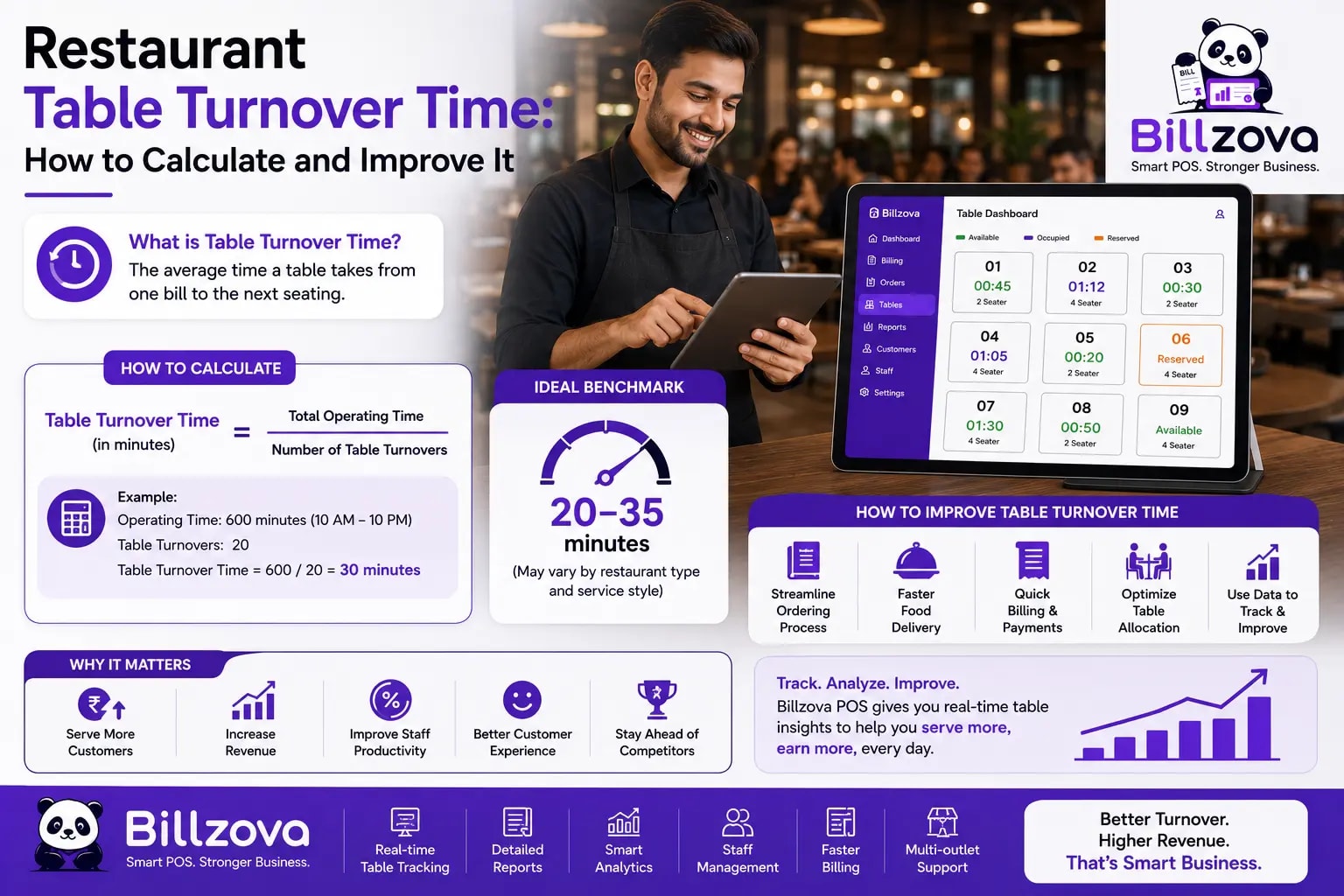
Every restaurant owner has an intuitive sense of how fast tables turn on a given night — "we were slammed," "things moved well tonight," "that four-top sat there forever." What's rarer is actually knowing the number: how long, on average, a table occupies your floor from being seated to being cleared, and whether that number is getting better or worse over time. Without it, "we were slow tonight" stays a feeling instead of something you can actually track and improve against.
Benjamin Franklin
From Advice to a Young Tradesman, 1748
Nowhere is that more literally true in a restaurant than table turnover. A table that could have served three parties in an evening but only served two, because each occupied it longer than necessary, is real, calculable lost revenue — not from any single mistake, but from the accumulated effect of small delays at every stage of the meal. This guide covers how to actually measure turnover time, where it typically gets lost, and how to improve it without turning your restaurant into a place nobody wants to linger in.
What Table Turnover Time Actually Means
Table turnover time is the total duration a table is occupied by one party — from the moment they're seated to the moment the table is cleared and ready for the next party. Table turnover rate is the related but distinct metric: how many times a table turns over in a given period, usually a full service or a day.
The two move in opposite directions for the same underlying reason: a shorter turnover time produces a higher turnover rate, meaning more parties served, more revenue generated, from the exact same physical table and the exact same hours of operation. This is why turnover time matters even for restaurants not consciously trying to "rush" anyone — it's really a measure of how efficiently your floor is being used, not a target for how fast to move customers along.
How to Calculate It
Checklist
- Record the time a party is actually seated at their table
- Record the time the table is cleared and ready for the next party — not when the bill is paid, but when the table itself is genuinely available again
- Subtract seated time from cleared time to get that table's turnover time for that specific visit
- Average this across every table, every visit, over a full service or day to get your restaurant's typical turnover time
- Track it over time — a single night's number matters less than the trend across weeks and months
The most common measurement mistake is using payment time instead of clearing time as the endpoint — a table isn't actually available for the next party the moment the bill is paid if the group lingers afterward, or if bussing takes a few extra minutes. The real number you want is when the table is genuinely ready for the next seating, since that's what actually determines how many parties you can serve.
| Stage | Example Timestamp |
|---|---|
| Party seated | 7:15pm |
| Order placed | 7:24pm |
| Food served | 7:41pm |
| Bill requested and paid | 8:22pm |
| Table cleared and ready | 8:28pm |
In this illustrative example, total turnover time is 73 minutes — 8:28pm minus 7:15pm. Breaking it into stages, as shown, is what actually makes the number useful: a 9-minute gap between seating and ordering, a 17-minute kitchen wait, a 41-minute dining period, and a 6-minute clearing gap after payment. Each of these is a genuinely different lever to pull if the overall number needs improving, which is exactly why the total alone doesn't tell you much on its own.
What One Extra Turn a Night Is Actually Worth
Abstract minutes are hard to feel the weight of — a concrete revenue picture makes the stakes clearer. Take a restaurant with 15 dine-in tables, each currently turning over 2.5 times during a typical dinner service, at an average ticket of ₹850 per table.
₹6,375/night
The number itself is illustrative, not a guarantee — every restaurant's actual math depends on its own table count, ticket size, and how much genuine friction (versus intentional dining time) exists in its current turnover. But the mechanism is real and directly calculable for any restaurant willing to measure its own current baseline first.
What a "Good" Turnover Time Actually Looks Like
There's no single correct number that applies across every restaurant — a quick-service counter and a leisurely full-service dinner spot have completely different, entirely appropriate turnover expectations, and comparing one against the other's benchmark would be meaningless. The useful comparison is almost always against your own restaurant's own historical baseline: is turnover time trending shorter or longer over recent weeks, and does that trend correlate with anything you've changed operationally?
It's also worth resisting the temptation to chase an aggressive, universal target borrowed from a different restaurant format entirely. A fine-dining restaurant deliberately encouraging longer stays is optimizing correctly for its own business model, even though its turnover time would look "bad" by a fast-casual restaurant's standard — the number only means something in the context of what kind of experience your restaurant is actually selling.
The Four Stages of a Table's Timeline
Breaking turnover time into its component stages — as in the worked example above — is what turns a single, hard-to-act-on number into several specific, addressable questions.
| Stage | What's Happening | Typical Bottleneck |
|---|---|---|
| Seated → Ordered | Guests review the menu and decide | Wait for server attention during a rush |
| Ordered → Served | Kitchen prepares the order | Kitchen queue depth, prep complexity |
| Served → Bill Requested | The actual meal and conversation | Largely intentional — this is the dining experience itself |
| Bill Requested → Cleared | Settling up and vacating | Wait for a server, or a slow group payment split |
Notice that only three of the four stages are realistic candidates for improvement — the middle "served → bill requested" stage is, for most restaurants, the actual dining experience, and shortening it aggressively risks making guests feel rushed rather than genuinely improving anything meaningful about the business.
Where Turnover Time Gets Lost
The seated-to-ordered gap is often the single most improvable stage, and it's exactly the bottleneck covered in our guide on QR code ordering — a table that can place its order the moment they're ready, without waiting for a server to become free, removes this entire waiting period for parties who'd rather order that way, while still leaving the traditional path available for anyone who prefers it.
The ordered-to-served gap is largely a kitchen operations question — how quickly and reliably orders reach the kitchen and get prepared. A slow or error-prone kitchen ticket process adds real, avoidable time here.
The bill-requested-to-cleared gap is where a slow, manual bill split can add real, avoidable minutes to a large table's turnover — precisely the friction covered in our bill splitting guide. A group waiting on hand-calculated math to figure out who owes what is a group that hasn't vacated the table yet, and every minute of that math is a minute the table isn't available for the next party.
A related, if less obvious, drag on effective turnover is a reservation system that doesn't handle no-shows well — a table held for a booking that never arrives isn't "turning over" at all during that window, a specific problem covered in our guide on reducing restaurant no-shows.
Turning Turnover Time Into a Report You Actually Check
Manually timing and logging every table's stages by hand isn't realistic on an ongoing basis — the real value of tracking turnover time comes from it being a natural byproduct of your existing operations, not a separate manual timing exercise layered on top of already-busy service. A system where table status updates automatically as orders are placed, served, and billed produces this data as a side effect of normal operations, the same underlying idea covered in our table management guide.
The specific report worth building a habit around, covered in more depth in our sales reporting guide, is a regular — weekly is usually enough — look at average turnover time, broken down by day of week and by time slot, rather than a single blended number for the whole period. A Saturday dinner rush and a quiet Tuesday lunch shouldn't be averaged together if you actually want to know where your real opportunity for improvement is.
Practical Ways to Improve Turnover Without Rushing Customers
Best Practice
- Reduce the ordering wait, not the dining time — give guests a faster path to placing their order without touching how long they're welcome to stay afterward
- Speed up kitchen ticket delivery and routing so food reaches the table faster once ordered
- Make settling the bill fast and accurate, especially for larger groups splitting several ways
- Train staff to proactively offer the check once it's clear a table is winding down, rather than waiting to be flagged
- Use reservation data to seat efficiently — knowing expected turnover helps avoid both empty tables and overbooked ones
Notice what's absent from this list: nothing here involves visibly rushing a guest mid-meal, which is exactly the wrong lever to pull and the one most likely to damage the actual dining experience for a marginal turnover gain.
When Faster Turnover Is NOT the Right Goal
It's worth stating plainly: turnover time is one input into a restaurant's performance, not the only one, and optimizing it in isolation can genuinely backfire. A restaurant built around a leisurely, extended dining experience — the kind where guests linger over a long dinner deliberately — is selling exactly that experience, and aggressively shortening turnover there would undermine the actual product being sold, even if the raw number looked better on a report.
The right question isn't "how do we make turnover as fast as possible," it's "where is time being lost to friction rather than to the actual experience we're selling" — the ordering wait, the kitchen delay, the bill-splitting math are all friction. The meal itself, for most restaurants, isn't.
A useful gut check before making any change aimed at turnover: would a regular, loyal customer notice and mind this specific change? Faster order placement, quicker kitchen delivery, and simpler bill settlement are all things most guests would welcome, not resent. A server hovering to clear plates the moment the last bite is finished, or subtly discouraging a table from ordering dessert, is a different kind of change entirely — one a regular would likely notice, and not in a good way.
Turnover Time and Reservations: Two Numbers That Interact
A reservation system that doesn't account for realistic turnover time creates its own quiet source of friction — booking tables back-to-back based on an overly optimistic turnover estimate means the next reservation arrives while the current table is still finishing up, creating an awkward wait that has nothing to do with kitchen speed or ordering friction, and everything to do with a scheduling assumption that didn't match reality.
Once you have a real, measured turnover time — broken down by party size and day of week, since both affect it meaningfully — that same number becomes useful input for how tightly reservations can realistically be booked. A restaurant that knows its typical four-top turns in roughly 75 minutes can book reservations with a genuinely realistic buffer, rather than guessing and either overbooking (creating waits) or underbooking (leaving tables empty that could have taken another party).
Section-by-Section and Shift-by-Shift Patterns
Averaging turnover time across your entire restaurant and every shift hides real, useful variation. A patio section might turn over faster than an indoor section on a pleasant evening, simply because outdoor seating tends to feel less suited to lingering. A weekday lunch crowd typically turns over faster than a weekend dinner crowd, for reasons that have nothing to do with your restaurant's own efficiency — it's a different occasion entirely, with different guest expectations.
Breaking turnover data down this way — by section, by shift, by day — before drawing conclusions prevents a common mistake: assuming a restaurant-wide efficiency problem when the real explanation is simply that different shifts and sections naturally behave differently, and blending them together obscures which comparisons are actually meaningful.
Frequently Asked Questions
What's a typical table turnover time for a full-service restaurant?
It varies too much by format, price point, and concept to quote a single universal number meaningfully — the more useful benchmark is your own restaurant's own trend over time, not a generic industry figure that may not reflect your specific business.
Does faster turnover always mean more revenue?
Generally, yes, up to the point where speed starts damaging the guest experience or average order value — a faster-turning table that also orders less, or leaves a worse impression that reduces return visits, isn't a clear win even if the raw turnover number improved.
Should turnover time be tracked per table or restaurant-wide?
Both are useful for different reasons — restaurant-wide trends show overall efficiency, while per-table or per-section data can reveal a specific physical bottleneck, like one section consistently running slower than the rest of the floor.
How does party size affect turnover time expectations?
Larger parties generally take longer at every stage — more time to decide as a group, more complex kitchen coordination, more complex bill settlement — so comparing a two-top's turnover time directly against an eight-top's isn't a fair comparison without accounting for size.
Can improving turnover time hurt customer satisfaction?
It can, specifically if the improvement comes from visibly rushing guests rather than removing genuine friction like ordering or payment delays — the distinction covered throughout this guide between "friction" and "the actual dining experience" is exactly what determines whether a turnover improvement helps or hurts satisfaction.
Is table turnover time relevant for a restaurant that does mostly takeaway and delivery?
Less directly — turnover time specifically describes dine-in table usage, so a primarily takeaway or delivery operation would look at a different set of speed metrics, like order-to-ready time, rather than table turnover per se.
How long should I collect data before trusting my turnover time numbers?
At least a few full weeks, ideally spanning both weekday and weekend service, before drawing firm conclusions — a single night's numbers, especially an unusually busy or quiet one, aren't a reliable baseline on their own.
Does staff training affect turnover time more than menu design does?
Both matter, in different stages — staff efficiency affects the ordering and payment stages most directly, while menu design (how easy items are to explain and decide on, how quickly dishes are actually prepared) affects the ordering and kitchen stages. Neither alone accounts for the full picture.
Can table turnover time data help with staffing decisions?
Yes — knowing which shifts and sections have the longest turnover times, and why, is useful context for deciding where additional staff would actually help versus where the current pace is simply appropriate for that shift's style of service.
Does adding more menu items increase turnover time?
It can, if a larger menu means guests take longer to decide — this is a real, if often overlooked, connection between menu design and floor efficiency, worth considering alongside purely operational fixes.
The Bottom Line
Table turnover time isn't about rushing anyone — it's about finding and removing the friction that has nothing to do with the meal itself: the wait to order, the wait for food, the wait to pay. Measured honestly and broken into its real stages, it turns a vague nightly impression into a specific, trackable number you can actually improve, one stage at a time, without touching the part of the experience your customers are actually there for.
billzova's table management keeps table status updated automatically as orders move through your kitchen and billing, feeding directly into the sales and reporting you'd need to actually track turnover over time — included standard at ₹399/month, with your first month free. The number itself won't fix anything on its own, but it turns "we were slow tonight" into a specific, addressable question you can actually answer with data instead of a feeling.
Billzova Team
Restaurant POS & Billing Experts
We build Billzova — GST billing, KOT, offline mode, inventory and reports for Indian restaurants. This team writes from what we see helping real restaurants bill faster every day.
Run your restaurant on billzova
GST billing, KOT, offline mode, inventory & reports in one app. ₹399/month — first month free.