Menu Engineering: How to Price Your Menu Using Real Recipe Costs
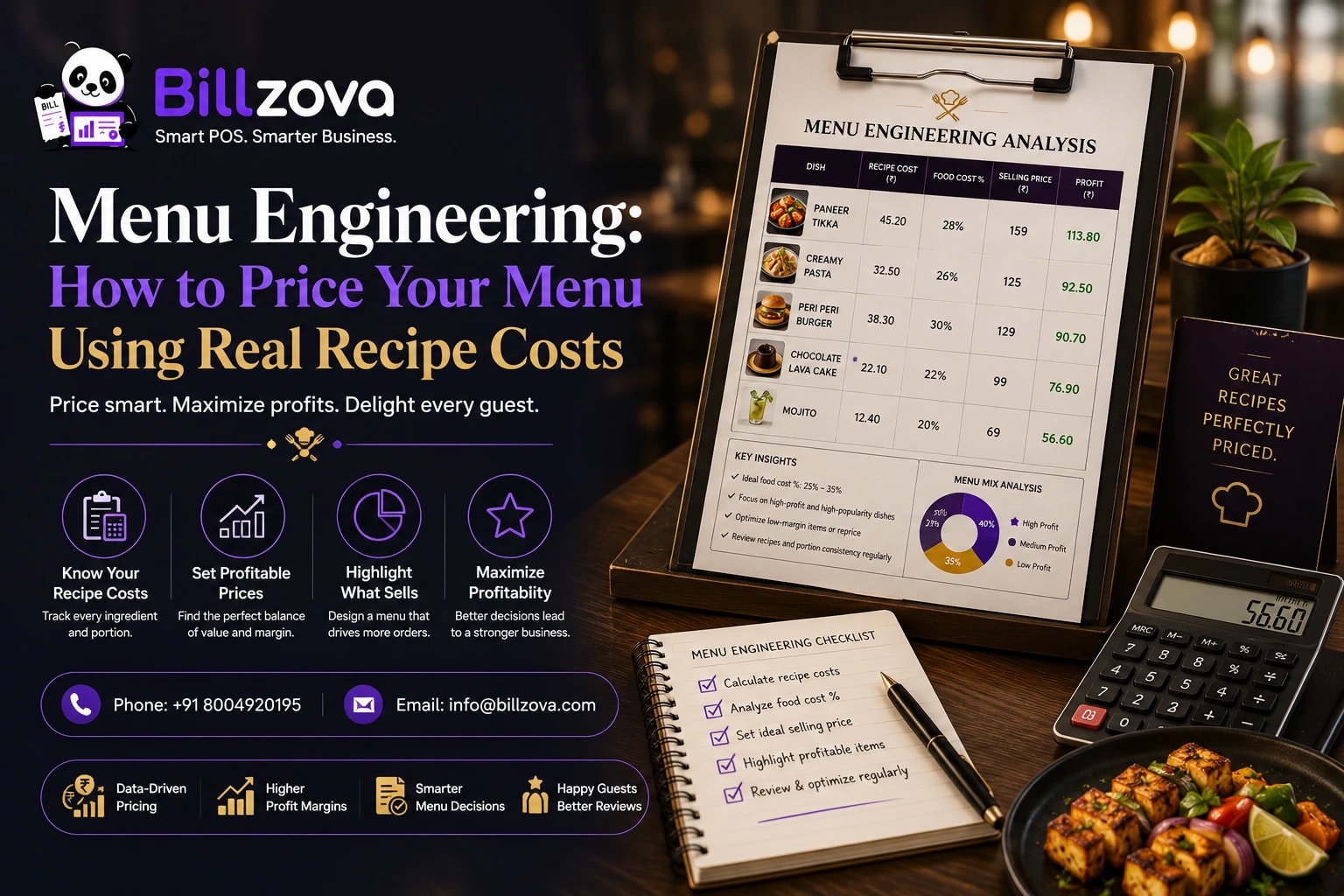
Most restaurant menus get priced once — at opening, based on some mix of gut feeling, what competitors charge, and a rough sense of what customers will accept — and then barely get revisited. Dishes get added, seasonal specials come and go, but the actual pricing logic behind the core menu often hasn't been seriously reconsidered in years, even as ingredient costs have quietly moved the entire time.
Menu engineering is the discipline of fixing that: pricing and positioning your menu based on what each dish actually costs and how well it actually sells, rather than instinct alone. It's not a new idea — restaurant consultants have used some version of this framework since the 1980s — but it's one most independent restaurants never formally apply, mostly because the hard part isn't the framework itself. It's getting an accurate cost for every dish in the first place, and keeping that cost current as your ingredients and their prices keep changing underneath you.
Warren Buffett
Investor, Chairman of Berkshire Hathaway
That distinction matters for a menu in a very literal sense. A dish's menu price is what the customer pays. Its actual cost — and therefore its real profitability — is a completely separate number, one most restaurants have never precisely calculated for every item they sell. Menu engineering is the process of finally connecting those two numbers, dish by dish, instead of pricing on instinct and hoping the overall math works out.
What Menu Engineering Actually Means
At its core, menu engineering plots every dish on your menu against two independent measures: how popular it is (how often it sells, relative to other items) and how profitable it is (its margin, once its real cost is known). Crossing those two dimensions produces four categories, each calling for a different action.
| Quadrant | Popularity | Profitability | What To Do |
|---|---|---|---|
| Stars | High | High | Protect and promote — these are your best dishes on both counts |
| Plowhorses | High | Low | Popular but thin margin — look for a way to raise price or trim cost without hurting demand |
| Puzzles | Low | High | Profitable but under-ordered — worth better placement or promotion, since each sale is valuable |
| Dogs | Low | Low | Neither sells well nor makes money — a genuine candidate for removal or a full rework |
The value of this framework isn't the labels themselves — it's what it forces you to actually check before making a decision. Without it, a restaurant's instinct is usually to focus entirely on what sells, since that's the visible, obvious signal. Menu engineering adds the invisible half of the picture: whether what sells is actually making you money, and whether what's quietly profitable is being under-promoted simply because nobody's looking at it that way.
The framework traces back to hospitality researchers Michael Kasavana and Donald Smith, who formalized this exact popularity-versus-profitability analysis for restaurant menus in the early 1980s. It's held up for over four decades because the underlying logic doesn't depend on any particular cuisine, price point, or market — it's really just a structured way of asking two questions every restaurant should already care about, together instead of separately.
Why You Can't Do Menu Engineering Without Real Recipe Costs
Popularity is easy to measure — your sales reports already show you exactly how often each dish sells. Profitability is the harder half, and it's exactly where most attempts at menu engineering quietly fall apart: without a real, accurate cost for each dish, you're guessing at the profitability axis, which makes the whole exercise unreliable from the start.
A dish's real cost isn't its most expensive ingredient, and it isn't a rough mental estimate — it's the sum of every ingredient in its recipe, at real current quantities and real current rates. Skip this step, or estimate it loosely, and you risk classifying a genuinely low-margin dish as a Star simply because it sells well, when a precise cost calculation would have shown it belongs in the Plowhorse category and needs a price adjustment.
How to Actually Calculate a Dish's Real Cost
Best Practice
- Break every dish down into its exact recipe — each ingredient and the precise quantity used per serving
- Price each ingredient at your actual current cost per unit, not a rounded estimate
- Sum the ingredient costs to get the dish's true cost per serving
- Divide that cost by the menu price to get the dish's food cost percentage
- Recalculate whenever an ingredient's price changes — a stale cost is a false cost
- Repeat for every dish, not just the ones you suspect might be a problem
That last point matters more than it might seem. It's tempting to only closely cost the dishes you already suspect are thin-margin, but the entire value of menu engineering comes from seeing the whole picture at once — including the dishes you'd have assumed were fine, which sometimes turn out not to be, once actually calculated rather than estimated.
Food Cost Percentage: What It Tells You (And What It Doesn't)
Food cost percentage — a dish's ingredient cost as a share of its menu price — is the most common single metric used in this kind of analysis, and it's useful, but it's worth understanding its limits too. A lower food cost percentage isn't automatically better in isolation; a dish with a higher food cost percentage but a much higher absolute margin in rupees can still be more valuable to your business than a "leaner" dish that barely moves any real profit per sale.
The metric that actually matters most for decision-making is contribution margin — the absolute rupee amount a dish contributes toward your overhead and profit, not just its percentage. A ₹350 dish at 35% food cost contributes roughly ₹227 per sale. A ₹150 dish at 25% food cost — a "better" percentage — contributes only about ₹112. Food cost percentage is a useful diagnostic; contribution margin is usually the better number to actually prioritize by.
The Four Quadrants in Practice — What to Do With Each
Stars need protection, not tinkering. A dish that's both popular and profitable is working — the main risk is a well-intentioned change (a recipe tweak, a price increase to "capture more value") that accidentally damages what's already succeeding. Small, careful moves only, if any.
Plowhorses need a careful price or cost adjustment. These dishes prove there's real demand — the problem is purely margin. A modest price increase is often absorbed without hurting sales, precisely because the dish is already popular enough that a small increase rarely changes the buying decision. Alternatively, look for a portion or ingredient adjustment that trims cost without customers noticing a difference in the dish itself.
Puzzles need visibility, not a price change. A profitable dish nobody orders usually has a demand problem, not a pricing problem — cutting its price further won't fix low awareness. Better menu placement, a server recommendation, or simply a more appealing description often does more than any pricing lever here.
Dogs need an honest decision. Neither popular nor profitable is the hardest quadrant to have on a menu, and the honest options are limited: a genuine rework of the dish, or removal. Keeping a Dog on the menu out of habit or sentiment is a real, ongoing cost with essentially no offsetting benefit.
Common Menu Engineering Mistakes
Estimating cost instead of calculating it. A rough guess at a dish's cost defeats the entire purpose — the whole value of the exercise comes from an accurate profitability axis, and an estimated cost produces an unreliable classification that can point you toward the wrong action entirely.
Using revenue instead of contribution margin to judge "profitability." A high-priced dish isn't automatically a Star just because it generates a lot of revenue — if its cost is proportionally high too, its actual contribution might be modest. Profitability in this framework specifically means margin, not top-line sales.
Treating the classification as permanent. A dish's quadrant isn't fixed — it shifts as ingredient costs move and as customer preferences change. Classifying once and never revisiting defeats the ongoing value of the exercise, turning a genuinely useful habit into a one-time report that goes stale within a season.
Reacting to popularity data with too small a sample. A new dish that's only been on the menu for two weeks doesn't have a reliable popularity signal yet — judging it against long-standing menu items too early risks cutting something that simply hasn't had time to build an audience.
Repricing Without Alienating Regulars
Tip
It also helps to reprice alongside some other menu change — a refreshed description, a small recipe improvement, a new specials rotation — so a price adjustment reads as part of a broader update rather than an isolated, easily-noticed increase on one specific item regulars have memorized the old price for.
What Happens When Ingredient Costs Change
Menu engineering isn't a one-time project — it's undermined the moment you treat it that way. Ingredient costs move constantly, and a dish correctly classified as a Star six months ago can quietly drift toward Plowhorse territory as its input costs rise, with the menu price never adjusting to reflect it. This is exactly the "silent erosion" pattern that makes periodic, manual food-cost reviews insufficient on their own — by the time a monthly or quarterly review catches a cost increase, months of eroded margin have already passed uncounted.
A system that recalculates a dish's real cost automatically the moment an ingredient's rate changes — rather than only at the next scheduled review — closes that gap directly. The classification itself doesn't need to be redone constantly, but the underlying cost data it depends on should always be current, not a snapshot from whenever someone last got around to checking.
A Worked Example: Repricing One Menu Section
Concrete numbers help more than the framework alone. Here's an illustrative starters section, costed and classified.
| Dish | Menu Price | Real Cost | Food Cost % | Popularity | Quadrant |
|---|---|---|---|---|---|
| Paneer Tikka | ₹280 | ₹68 | 24% | High | Star |
| Veg Spring Rolls | ₹220 | ₹95 | 43% | High | Plowhorse |
| Stuffed Mushrooms | ₹260 | ₹62 | 24% | Low | Puzzle |
| Continental Platter | ₹340 | ₹165 | 49% | Low | Dog |
In this illustrative section: Paneer Tikka needs nothing but continued visibility — it's already working. Veg Spring Rolls, popular but thin, is a candidate for a modest price increase or a slightly leaner portion of oil in prep. Stuffed Mushrooms, quietly profitable but under-ordered, might do better with a spot higher on the menu or a mention from servers. The Continental Platter — expensive to make and rarely chosen — is the one worth a hard conversation: rework it meaningfully, or retire it.
How Often Should You Actually Revisit Pricing
A full menu engineering pass — reclassifying every dish — is realistically a quarterly exercise for most restaurants; doing it more often rarely reveals enough change to justify the effort, and doing it less often risks letting a real problem run unnoticed for too long. Ingredient cost tracking itself, by contrast, should be continuous, not tied to the same quarterly cadence — the cost data feeding your next review should always be current, even if the review itself happens on a slower rhythm.
This connects directly to the food waste side of cost control too — a dish whose real all-in cost includes a meaningful hidden waste pattern is quietly more expensive than its recipe cost alone suggests, a link covered in more depth in our guide to measuring what food waste actually costs. It also sits alongside the broader cost-control discipline covered in our restaurant profit margin guide — menu engineering is really the dish-by-dish application of the same underlying logic.
4 quadrants
Menu Engineering and Seasonal Ingredient Costs
India's produce and protein markets carry real seasonal swings — monsoon-affected vegetable prices, festival-season demand spikes on certain ingredients, and other predictable seasonal shifts most restaurants already have some intuitive sense of. Menu engineering benefits directly from folding that seasonality in, rather than treating cost as a flat, year-round constant.
A dish that's comfortably a Star in winter, when its key ingredient is cheap and abundant, can genuinely slide toward Plowhorse territory during a seasonal price spike, if the menu price never adjusts. Restaurants that build seasonal awareness into their pricing — even informally, like reviewing costs specifically going into a known high-price season — catch this shift proactively instead of discovering it after a quarter of eroded margin on a dish everyone still assumed was performing the same as always.
Frequently Asked Questions
What's the difference between menu engineering and just tracking food cost percentage?
Food cost percentage is one input into menu engineering, not the whole picture. Menu engineering also weighs popularity and contribution margin, and it explicitly leads to a specific action per dish — reprice, promote, rework, or remove — rather than just a number to note and move past.
Do I need software to do menu engineering, or can it be done on paper?
It can be done manually, but accurately costing every dish by hand, and keeping that cost current as ingredient prices change, is real, repeated work — which is exactly why many restaurants that try it on paper do it once and never repeat the exercise regularly.
How many dishes should a menu realistically have after applying this?
There's no universal target number — the right menu size depends on your kitchen's capacity and your concept. The value of menu engineering isn't shrinking the menu for its own sake; it's making sure every dish that stays on it is there for a specific, understood reason.
Should seasonal or limited-time items go through the same analysis?
Costing, yes — you should always know a dish's real cost regardless of how long it's on the menu. Full quadrant classification matters less for genuinely short-lived specials, since popularity data needs real time to become meaningful.
Is a high food cost percentage always a problem?
Not necessarily — a premium dish with a higher food cost percentage but strong absolute contribution margin can still be more valuable than a cheaper dish with a "better" percentage but a smaller real rupee contribution. Percentage and contribution margin should be read together, not the percentage alone.
What should I do with a dish that's popular but I genuinely can't make profitable?
This is a real Plowhorse dilemma without a universal answer — options include a portion adjustment, a recipe simplification that maintains the dish's appeal at lower cost, or accepting a lower margin on that specific item because it drives traffic or complements higher-margin add-ons ordered alongside it.
Does menu placement (where a dish appears on the page) actually affect what sells?
Menu design and placement are a well-documented lever in how customers scan and choose from a menu — it's a genuinely useful tool specifically for the Puzzle quadrant, where the dish is already profitable and the main problem is visibility rather than the dish itself.
Should combo meals or thalis be costed the same way as individual dishes?
Yes, in principle — a combo's real cost is the sum of everything included in it, at real quantities and rates, the same underlying calculation as any single dish, just with more components to add up.
How does menu engineering handle dishes with highly variable ingredient costs, like seafood?
These need more frequent cost recalculation than stable, shelf-stable ingredients, since their real cost can shift meaningfully between reviews. This is exactly where automatic, rate-change-triggered recalculation matters more than a fixed quarterly check-in alone would catch.
Is it worth menu-engineering a very small menu, like a five-item cafe menu?
Yes — a smaller menu actually makes the exercise faster to complete, and getting the pricing right on a handful of core items matters proportionally more when there are fewer dishes to spread risk across.
Can menu engineering help decide what to add to a menu, not just what's already on it?
Indirectly — knowing which existing categories are strong on both popularity and margin gives a reasonable signal for where a new addition is more likely to succeed, though a genuinely new dish still needs real sales data of its own before it can be properly classified.
The Bottom Line
Menu engineering isn't a one-time project or an intimidating consulting exercise — it's a habit of actually knowing, dish by dish, what something costs and how well it sells, instead of pricing by feel and hoping the totals work out. The framework itself is simple, and it doesn't require a consultant or specialized training to apply correctly once the underlying numbers are trustworthy. The part that actually requires real infrastructure is keeping every dish's real cost current as ingredient prices move, continuously, not just whenever someone remembers to check.
billzova's recipe costing calculates real cost per serving from your actual ingredients and current rates, recalculating automatically the moment a rate changes, with food cost tracking against a target across your whole menu — included standard at ₹399/month, with your first month free. Once every dish has a real, current cost behind it, the four-quadrant classification in this guide becomes something you can actually run on real numbers, not estimates — and revisit as often as it's actually useful, not just whenever someone finds the time to reconstruct the costs from scratch.
Billzova Team
Restaurant POS & Billing Experts
We build Billzova — GST billing, KOT, offline mode, inventory and reports for Indian restaurants. This team writes from what we see helping real restaurants bill faster every day.
Run your restaurant on billzova
GST billing, KOT, offline mode, inventory & reports in one app. ₹399/month — first month free.