Cloud Kitchen vs Dark Store vs Ghost Kitchen: What Is the Difference?
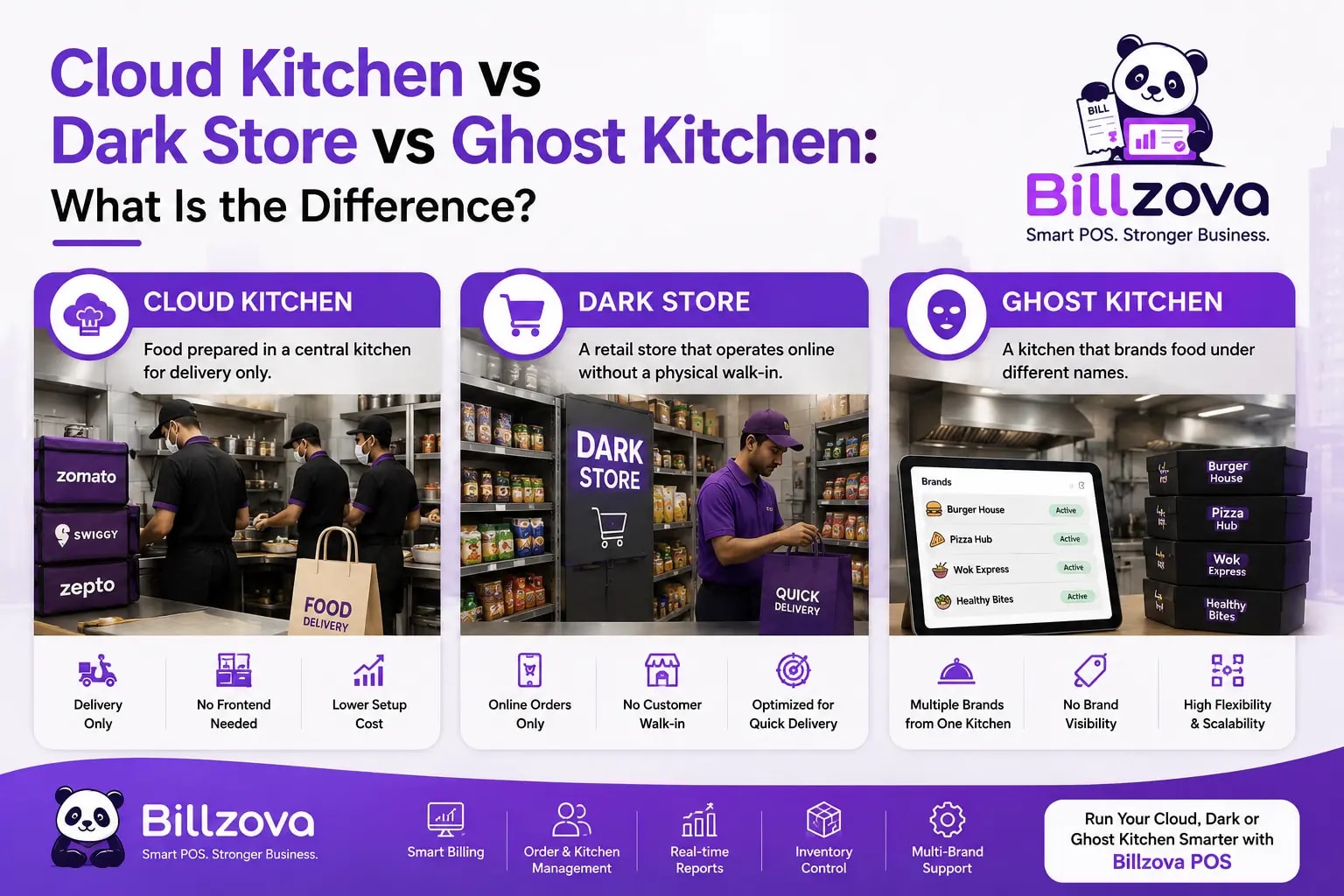
Cloud kitchen, ghost kitchen, dark kitchen, dark store — four terms, used almost interchangeably in casual conversation, and genuinely different from each other in ways that matter if you're actually deciding how to set one up. Three of them describe food-preparation businesses with real overlap. The fourth — dark store — isn't a food business at all, and the fact that it keeps getting lumped in with the other three is exactly the kind of confusion worth clearing up directly.
The Short Answer
A cloud kitchen is a delivery-only kitchen operating one or more of its own brands, with full control over the brand and menu. A ghost kitchen specifically emphasizes brand invisibility — the customer orders from a brand they recognize online with no idea where or how it's actually made, sometimes from a kitchen also producing several other unrelated brands. A dark kitchen is often used as a near-synonym for either of the above, though it more precisely describes a shared, rented kitchen facility hosting multiple independent food businesses under one roof. A dark store, despite the naming similarity, isn't a kitchen at all — it's a quick-commerce fulfillment warehouse for grocery and retail orders, with no food preparation happening inside it whatsoever.
Cloud Kitchen: Your Brand, No Dine-In Space
A cloud kitchen is the most straightforward of the three food-related terms: a delivery-only restaurant operation with no physical dining space, taking orders through apps, websites, or direct channels, and cooking purely for delivery or pickup. The defining feature is ownership — a cloud kitchen operator typically runs their own brand (or brands) with full control over the menu, pricing, and customer relationship, even though there's no storefront for a customer to walk into.
Most cloud kitchen operators run more than one brand from the same physical kitchen once volume justifies it — a biryani brand and a dessert brand sharing one kitchen and one set of equipment, for instance, to spread fixed costs across more revenue without opening a second location.
Ghost Kitchen: The Branding Layer
A ghost kitchen isn't a structurally different kind of kitchen so much as a specific emphasis on brand invisibility. The customer sees a digital storefront and a brand name on a delivery app; they have no visibility into — and generally no reason to know — which physical kitchen actually produced the food, or whether that kitchen is also making food for three other brands at the same time. In practice, "ghost kitchen" and "cloud kitchen" are used interchangeably by most people, and the distinction matters more to industry analysts than to a restaurant owner actually deciding how to set one up.
Dark Kitchen: Often the Same Thing, Sometimes a Shared Space
"Dark kitchen" is frequently used as a straightforward synonym for cloud or ghost kitchen — a kitchen with no customer-facing dine-in area, full stop. Where it sometimes means something more specific: a shared, professionally operated kitchen facility rented out to multiple independent food businesses, each running its own brand but sharing physical space, and sometimes equipment or staff, with other unrelated operators in the same building. Whether "dark kitchen" means "delivery-only kitchen" generically or "shared rented kitchen space" specifically usually has to be inferred from context — the term itself doesn't reliably distinguish the two.
Dark Store: Not a Food Business At All
Warning
The confusion is understandable — both "dark store" and "dark kitchen" describe unstaffed-facing, delivery-oriented, hidden-from-customers operations, and both terms entered common usage around the same quick-commerce boom. But a dark store's entire purpose is moving pre-made physical goods off a shelf as fast as possible; a cloud kitchen's entire purpose is cooking food to order. They solve completely different logistics problems and, in practice, are run by completely different kinds of operators.
| Cloud Kitchen | Ghost Kitchen | Dark Kitchen | Dark Store | |
|---|---|---|---|---|
| What it actually is | Delivery-only kitchen, own brand(s) | Delivery-only kitchen, brand-invisible to diners | Often a synonym; sometimes a shared rented kitchen | Quick-commerce grocery/retail warehouse |
| Food prepared on-site? | Yes | Yes | Yes | No — no cooking happens here |
| Customer-facing dine-in? | No | No | No | No (not applicable — not a food business) |
| Typical operator | Independent brand owner | Independent brand owner, digital-first | Multiple independent tenants sharing space | Grocery/quick-commerce retailer |
Why This Matters Beyond Terminology
Getting the terms right isn't pedantry — the operational reality behind each label is genuinely different, and confusing them leads to real planning mistakes. A prospective operator researching "dark store" costs and logistics when they actually mean "cloud kitchen" will end up sizing their plan around retail fulfillment throughput instead of kitchen prep capacity, staffing for pickers instead of cooks, and benchmarking against the wrong competitors entirely.
For anyone actually setting up a delivery-only food operation — whichever of the three food-related terms fits your specific model — the same underlying operational needs apply: a kitchen genuinely built for delivery order flow, a system that can handle more than one brand if that's part of the plan, and per-station routing so a growing menu doesn't turn into shouted chaos across the kitchen during a rush.
What Running One Actually Requires, Operationally
Whether you call it a cloud kitchen, ghost kitchen, or dark kitchen, a real delivery-only food operation has a specific set of operational needs that a dine-in-first POS often wasn't built around:
Best Practice
- Order capture that models the full delivery flow — customer, address, rider, status from received through delivered, not just "order placed"
- KOT routing per kitchen station, so the right ticket reaches the right cook automatically as the menu and stations grow
- Genuine multi-brand support if running more than one label from the same kitchen — separate menu, separate invoice template, separate GSTIN and FSSAI where applicable per brand
- Recipe-linked inventory that auto-deducts stock per bill, so food cost per dish is a real number, not a guess
- Reliability that doesn't depend on a stable internet connection during a dinner rush
On the multi-brand point specifically: it's worth being direct that most cloud kitchens don't get aggregator orders flowing in through a live API connection today — Zomato and Swiggy orders are commonly entered once, by staff, into whatever system the kitchen actually runs on. That single point of entry is still what keeps KOT routing, inventory deduction, and reporting unified across every channel, which matters more once a kitchen is running two or three brands at once and can't afford confusion about which ticket belongs to which brand.
₹399/month
Why Operators Run Multiple Virtual Brands From One Kitchen
The multi-brand strategy behind most cloud kitchens isn't just about spreading fixed costs — it's also a deliberate response to how aggregator apps actually work. A single restaurant listing shows up under one cuisine category, competing against every other biryani place in a two-kilometer radius. The same kitchen listed as three separate brands — a biryani specialist, a north-Indian thali brand, and a dessert-only label — shows up in three separate search categories, reaches three different customer intents, and can be positioned, priced, and marketed independently even though every order is cooked in the same physical space by largely the same staff.
This is precisely where the terminology confusion causes real operational risk: a kitchen running three virtual brands still needs every one of those brands billed correctly — separate GST invoice, correct GSTIN, correct FSSAI reference where applicable — because from a tax and compliance standpoint, each brand is still a real, separately invoiced sale, regardless of how invisible the shared kitchen is to the end customer. A system that treats "three brands" as one undifferentiated stream of orders creates a reconciliation headache at exactly the point where the multi-brand strategy is supposed to be making things easier, not harder.
The Economics: Why Delivery-Only Is Attractive, and Where It Isn't Free
The appeal of the cloud/ghost/dark kitchen model is real: no dining room means no interior fit-out cost, no front-of-house staff, and typically a smaller, cheaper physical footprint than a dine-in restaurant needs for the same kitchen output. For a first-time operator or someone testing a new brand concept, that lower upfront capital requirement is often the entire reason delivery-only is attractive over opening a full restaurant.
What that comparison tends to leave out: aggregator platform commissions on every single delivery order are a real, recurring cost that a dine-in restaurant's walk-in customers simply don't carry, and a delivery-only brand has no organic footfall at all — every single customer has to be actively acquired through an app, a search result, or paid marketing, since there's no storefront for anyone to walk past. A honest comparison isn't "delivery-only is cheaper" full stop; it's "delivery-only trades upfront capital cost for ongoing acquisition and platform-commission cost," and which trade-off makes more sense depends heavily on the specific brand and market.
A Worked Example: One Kitchen, Three Brands
Consider a kitchen running three virtual brands — call them a biryani label, a rolls-and-wraps label, and a dessert label — from a single 400-square-foot space with one set of core equipment. During a lunch rush, orders for all three brands can arrive within seconds of each other across different aggregator tablets plus direct WhatsApp orders. Without brand-tagged KOT routing, a cook has to mentally track which ticket belongs to which brand while also tracking which station — tandoor, frying, packing — each item needs, which is exactly the kind of manual coordination that breaks down under real order volume and produces the wrong item going into the wrong brand's packaging.
With brand-tagged, station-routed KOTs, the same rush becomes mechanical rather than chaotic: each ticket printed or displayed at the right station already carries its brand identity, packaging staff know which brand's packaging to reach for without asking, and end-of-day reporting splits cleanly by brand without anyone manually sorting through a single combined order list after the fact. The kitchen itself hasn't changed — the same equipment, largely the same staff — but the operational clarity is the difference between a rush that runs smoothly and one that generates wrong-order complaints on three separate aggregator apps simultaneously.
Which Model Actually Fits Your Situation
If you're building your own brand with full control over menu and pricing and have no interest in a physical storefront, that's a cloud kitchen, plain and simple — the "ghost" framing doesn't change anything about how you'd actually run it. If you're renting kitchen space alongside other unrelated food businesses to keep upfront costs down while you prove out demand, that's the shared-space meaning of "dark kitchen," and your infrastructure needs (equipment, staffing, even your POS) may be partly shared with facility operators rather than fully in your control. If what you actually researched was fast grocery or retail delivery — not food at all — you're looking at a dark store, which is a genuinely different business with different licensing, different logistics, and honestly, a different guide than this one.
For anyone running multiple brands or multiple kitchen locations as the model scales, our multi-branch management checklist covers the operational side of running more than one location, and — since a cloud kitchen still needs the same FSSAI and GST registrations any restaurant needs, per brand and per location where applicable — our FSSAI and GST licensing guide covers exactly that requirement before you open.
How the Terms Actually Get Misused in Practice
A few real patterns worth knowing, since they explain most of the confusion this guide is untangling. News coverage and investor reporting tend to favor "ghost kitchen" because it sounds more dramatic and captures attention — a lot of what gets called a "ghost kitchen story" in the press is, operationally, just a cloud kitchen with a marketing-friendly label attached. Real estate and facility operators renting out shared kitchen space tend to favor "dark kitchen" specifically because it emphasizes the shared-infrastructure angle they're actually selling — space and equipment, not a brand. And "dark store" gets pulled into food-delivery conversations mostly because quick-commerce apps like Blinkit, Zepto, and Swiggy Instamart now sometimes deliver both groceries and ready-to-eat food from the same general geography, which blurs the line in a consumer's mind even though the underlying warehouse and kitchen operations remain entirely separate facilities with separate licensing, separate staffing, and separate supply chains.
None of this means the terms are meaningless — it means they're used loosely enough in casual conversation and press coverage that anyone actually planning to open one of these operations needs the more precise definitions in this guide, not the loosest common usage, to make real decisions about licensing, equipment, and system requirements.
A practical test that cuts through most of the loose usage: if there's a physical dining space customers walk into, none of these four terms apply — it's simply a restaurant, however it also chooses to handle delivery. If there's no dine-in space and food is being cooked to order, you're looking at some flavor of cloud, ghost, or dark kitchen, and which specific word gets used matters far less than whether the operation is actually built to handle delivery order flow, multi-brand complexity, and station-level routing correctly. And if nothing is being cooked at all — just physical goods being picked and packed for fast delivery — that's a dark store, and it's worth researching under its own, correct terminology rather than food-kitchen guides that don't actually apply to it.
Frequently Asked Questions
Is a ghost kitchen the same thing as a cloud kitchen?
In practice, yes, for almost all operational purposes — "ghost kitchen" just emphasizes that the customer has no visibility into who's actually cooking their order, while "cloud kitchen" is the more general, more commonly used term for the same delivery-only, no-dine-in business model.
Is a dark store the same as a dark kitchen?
No — this is the single most common point of confusion. A dark store is a quick-commerce warehouse for grocery and retail goods with no cooking involved; a dark kitchen is a food-preparation facility. They share naming conventions but are structurally different businesses.
Can one physical kitchen run more than one brand under this model?
Yes — this is extremely common and often the whole economic point of the model, spreading a single kitchen's fixed costs (rent, equipment, staff) across multiple brands and revenue streams rather than opening a second physical location for each new concept.
Do cloud kitchens need FSSAI and GST registration like any other restaurant?
Yes — a cloud kitchen is a commercial food business exactly like a dine-in restaurant for licensing purposes, and needs the same FSSAI tier (based on turnover) and GST registration (once the turnover threshold is crossed) as any other restaurant. Format doesn't exempt a business from either requirement.
Which model is cheaper to start — cloud kitchen or a traditional dine-in restaurant?
Generally a cloud kitchen, since it avoids the cost of a customer-facing dining space, furniture, and front-of-house staff entirely — though kitchen equipment, delivery logistics, and platform commission costs are real expenses that a comparison purely on rent tends to understate.
Do aggregator platforms like Zomato and Swiggy know or care which of these terms describes my kitchen?
Not really — from an aggregator platform's perspective, what matters is that a listed brand can fulfill orders reliably, not which of these industry labels its kitchen technically falls under. The terminology is more useful for your own planning and communication than for how the platforms themselves categorize you.
Can a dine-in restaurant also run a cloud kitchen brand from the same physical kitchen?
Yes, and this is a common way restaurants add revenue without opening a new location — an existing restaurant kitchen runs its regular dine-in menu alongside one or more delivery-only virtual brands during the same service hours, using existing equipment and staff capacity that would otherwise sit idle between rush periods.
How many virtual brands can realistically be run from one small kitchen?
There's no fixed number — it depends entirely on kitchen size, station capacity, and how much menu overlap the brands share. What matters operationally isn't the brand count itself but whether the kitchen's systems (KOT routing, inventory, reporting) can actually keep each brand distinct as volume grows, since that's where confusion and errors compound past a certain point.
Is "virtual restaurant" the same thing as any of these terms?
"Virtual restaurant" and "virtual brand" are generally used to describe the brand itself — the menu and identity a customer sees on an app — while cloud kitchen, ghost kitchen, and dark kitchen describe the physical kitchen operation behind it. A single physical kitchen can host several virtual restaurants at once.
The Bottom Line
Cloud kitchen, ghost kitchen, and dark kitchen describe real variations on the same delivery-only food business model, and for most operational decisions, the differences between them matter less than getting the fundamentals right — genuine delivery-order flow, reliable multi-brand support if you need it, and per-station KOT routing that scales with your menu. Dark store is the true outlier: a completely different business, in retail fulfillment, that only sounds related because of a naming coincidence.
If you're weighing which of these models to build, the terminology shouldn't be the hard part of the decision — the real questions are about capital, brand strategy, and whether your systems can keep multiple brands and stations straight once volume actually shows up. Get those right, and it genuinely doesn't matter much which of the three food-related labels ends up describing what you built.
billzova is a cloud kitchen POS built for delivery-first kitchens — instant KOT printing and a live kitchen display board, recipe-linked food costing, and full offline reliability, at ₹399/month flat, with your first month free.
Billzova Team
Restaurant POS & Billing Experts
We build Billzova — GST billing, KOT, offline mode, inventory and reports for Indian restaurants. This team writes from what we see helping real restaurants bill faster every day.
Run your restaurant on billzova
GST billing, KOT, offline mode, inventory & reports in one app. ₹399/month — first month free.