Splitting the Bill: How Restaurant POS Software Handles Group Payments
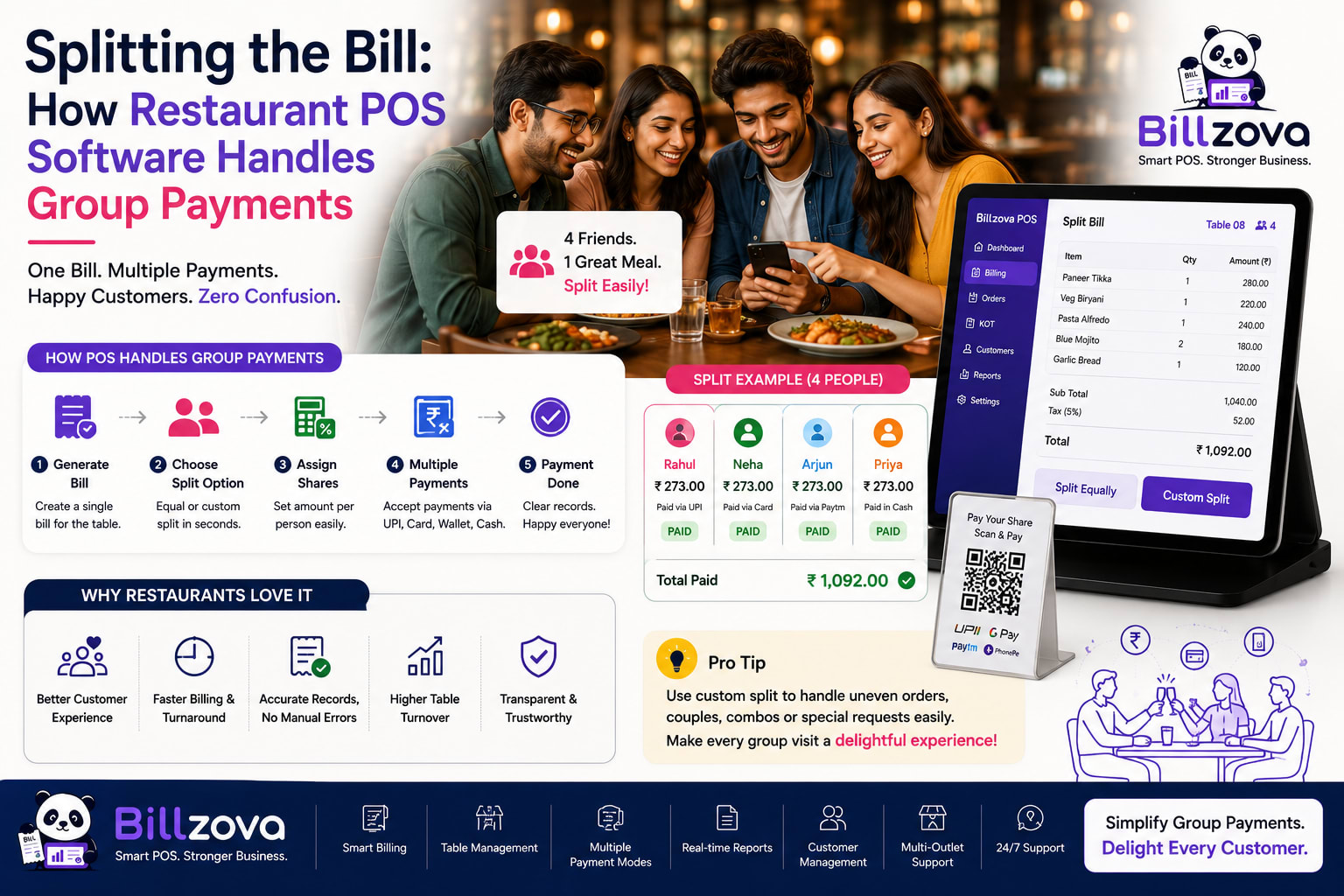
The meal is over, everyone's had a good time, and then comes the slightly awkward part: "so how are we splitting this?" Someone starts doing mental math. Someone else insists they only had a small plate and shouldn't pay an equal share. A third person just wants to pay for everyone and get reimbursed later, except nobody actually follows through on the reimbursement. Meanwhile, the server is standing there, waiting, while a five-minute conversation about money slowly unfolds at the table.
William Shakespeare
Hamlet, Act 1, Scene 3
Money between friends is always a little awkward, and a restaurant bill is one of the most common places that awkwardness plays out in public, at a table, with a server waiting. A restaurant can't fix the social dynamics of a group deciding how to split a bill — but it can make the mechanical part fast, accurate, and free of the arithmetic errors that make an already-awkward moment worse. This guide covers how that actually works.
The Three Ways Groups Actually Want to Split a Bill
Most group bill-splitting requests fall into one of three patterns, and a restaurant's billing system needs to genuinely support all three — not just the simplest one — because which pattern a given table wants depends entirely on that specific group, not on what's easiest for the POS to calculate.
| Split Type | How It Works | Typical Use Case |
|---|---|---|
| Equal split | Total divided evenly by number of guests | A group that ordered and shared everything together |
| Item-wise split | Each item assigned to whoever ordered it | A group where everyone ordered their own dish and wants to pay for exactly what they had |
| Custom split | Specific amounts entered per person | A group with its own informal arrangement — one person covering more, uneven contributions |
Forcing every group into one method — usually equal split, since it's the simplest to calculate by hand — is exactly what creates friction at the table. The person who had a water and a small appetizer, seated next to someone who ordered a full meal and drinks, has a legitimate reason to want an item-wise split instead, and manually recalculating that split by hand, under time pressure, with a server waiting, is where mistakes creep in. Supporting all three patterns properly means the restaurant never has to be the one insisting on a particular method that doesn't actually fit how a specific group wants to settle up.
Item-Wise Splitting: Assigning the Bill Before It's Even Requested
The most accurate — and most requested — type of split is item-wise: each item on the table's order tagged to whoever actually ordered it, with the bill calculated per person automatically once billing starts. Done well, this tagging happens naturally during order-taking, not as a separate reconstruction exercise at the end of the meal — a server assigns each item to a seat or guest name as the order is placed, so by the time the table asks to split the bill, the assignment already exists and the calculation is instant.
Shared items — a starter plate the whole table picked at, a bottle of wine split three ways — need their own handling too, since they don't belong to just one person. A properly built system lets a shared item be split proportionally across the guests who actually shared it, rather than forcing an awkward choice between assigning it entirely to one person or leaving it out of the itemized split altogether.
A Table of Six, Split Two Ways
Concrete numbers make the difference easier to picture. A table of six orders a mix of mains, shared starters, and drinks, totaling ₹3,600 before tax.
Manual equal split: The server divides ₹3,600 (plus tax) by six and announces the per-person amount. Two guests who only had a starter and a soft drink object — reasonably — that they shouldn't pay the same as the person who ordered a large main and two drinks. The table spends several minutes renegotiating who owes what, doing rough mental math on napkins, while the server waits and other tables go unattended.
Item-wise split, tagged during ordering: Each dish was already assigned to a guest when it was ordered. When the table asks to split, six individual, correctly-taxed amounts are ready in seconds — including a fair, proportional share of the one shared starter plate. No renegotiation, no napkin math, no held-up server. The two guests who ordered lighter pay less, accurately, without anyone having to advocate for themselves at the table.
6 receipts, 1 order
The GST Problem With Splitting a Bill
This is the part manual bill-splitting gets wrong most often, and it's a genuine compliance issue, not just an inconvenience: when a bill is split, the tax on that bill needs to be split correctly too — proportioned CGST and SGST per share, not just the pre-tax amount divided evenly while someone eyeballs the tax separately.
Warning
This connects directly to the invoice-structure discipline covered in our GST billing compliance guide — every invoice, split or not, needs the same correct CGST/SGST structure. A split bill is really just several smaller GST invoices generated from one table order, and each one needs to be individually correct, not just collectively adding up to the right total.
Mixed Payment Methods in One Split
Groups rarely pay uniformly. One person pays UPI, another hands over cash, a third puts their share on a card — and a restaurant's system needs to record all three correctly within the same table session, rather than forcing the whole table onto one payment method for the sake of simpler bookkeeping.
Checklist
- Each guest's share can be collected through whichever payment method they actually prefer
- Cash change calculation happens correctly per individual split, not against the table's full total
- Every payment mode used gets recorded accurately in daily reconciliation
- A guest who hasn't paid yet is clearly distinguishable from one who has, even mid-split
- The full session — every guest, every method, every amount — rolls up into one coherent record for that table
Without this, a restaurant either has to awkwardly insist the whole table pay the same way (friction at the table, again) or handle mixed payments through some manual workaround that makes end-of-day reconciliation genuinely harder, since the POS's own record doesn't match what actually happened at the table.
What Happens When Someone Leaves Early
A real, common scenario worth planning for explicitly: a group is mid-meal, and one person needs to leave before the table settles, wanting to pay and go. A good system handles this without disrupting everyone else still at the table — that person's items get billed and settled on their own, while the remaining order continues normally for whoever's still there, rather than forcing the entire table to settle prematurely just because one guest needed to leave first.
The reverse case matters too: an item initially assigned to someone who then leaves needs to be reassignable — either split among the remaining guests or absorbed by whoever's picking up the difference — without requiring the whole order to be voided and re-entered from scratch.
Corporate Groups and Individual Expense Receipts
Business dining brings its own specific requirement: several people at one table, each needing their own individual, GST-compliant receipt for their own company's expense reporting, rather than one shared bill nobody can individually claim. This is exactly where correctly proportioned tax per split stops being a nice-to-have and becomes the actual point — an expense receipt with an incorrect or estimated tax figure isn't usable for a corporate reimbursement claim.
A digital receipt option — sent directly to each guest rather than only a printed copy — adds real convenience here too, letting each person in a business dinner receive their own claim-ready receipt on their phone before they've even left the table, without waiting on a printer or the risk of a paper receipt getting lost before it reaches an expense report. Sending that receipt over WhatsApp specifically, covered in more depth in our WhatsApp invoicing guide, tends to reach people faster and more reliably than a paper slip that might not survive the trip back to the office.
Splitting and Customer Records
Group dining is also where a restaurant's customer records get the most real-world exercise — a table of six splitting individually is six separate opportunities to correctly capture a phone number or a name against a real visit, rather than one group visit logged under whichever single name the reservation happened to be under. Getting that capture right, consistently, is what makes the customer history and loyalty ideas covered in our restaurant CRM guide actually reflect reality, rather than under-counting everyone who visited as part of a group but never became "the" name on record.
Common Bill-Splitting Mistakes Restaurants Make Manually
Estimating instead of calculating shared items. "That appetizer was probably around ₹80 each" is a guess, not a calculation — and guesses at a table full of people watching the math tend to get questioned, which is exactly the friction good splitting is supposed to avoid.
Forgetting to validate the total. A custom split where the individually-entered amounts don't actually add up to the bill's real total is an easy manual error, one that's often only caught after everyone's already paid and left — at which point correcting it is far more awkward than catching it before payment.
Treating rounding inconsistently. An equal split that doesn't divide evenly needs a consistent rule for the leftover paisa — handled automatically and predictably, rather than an ad hoc decision made differently table to table.
Losing track of who's paid. On a busy night, a table with a complicated multi-person split is exactly where "wait, did that person already pay?" confusion happens — a real, trackable per-guest payment status prevents both double-charging and accidentally letting someone leave without paying.
Re-deriving the split from scratch every time it changes. Groups revise their minds mid-conversation — someone offers to cover a friend's share, another person remembers they should be excluded from a round they didn't drink. Recalculating the entire split by hand each time this happens is slow and error-prone in exactly the moments patience is already running thin.
Bill Splitting Needs Vary by Restaurant Type
| Restaurant Type | Most Common Split Need |
|---|---|
| Full-service, group dining | Item-wise, especially for larger tables ordering individually |
| Cafes & coffee shops | Mostly individual orders already — splitting matters less, but still needed for shared tables |
| Bars & pubs | Frequent equal splits for shared rounds, alongside individual tabs |
| Corporate & business dining | Individual GST receipts per guest, regardless of split method |
A restaurant that mostly serves solo diners and couples has a genuinely lighter need for sophisticated splitting than one that regularly hosts group dinners and celebrations — but almost every dine-in restaurant hits this need often enough that treating it as an afterthought creates real, repeated friction over time, table after table.
This ties into table turnover specifically for larger group tables — a slow, manual split on a big table doesn't just delay that table's own turnover, it delays every other table that server should be attending to during the same window, a dynamic covered in more depth in our guide on table management.
How to Handle Bill Splitting During a Rush
The value of fast, accurate splitting compounds specifically during peak hours, when a slow, error-prone manual split doesn't just inconvenience one table — it holds up a server who's needed elsewhere, and it's exactly the moment a mental-math mistake is most likely, since everyone involved is moving quickly under pressure.
A split that takes seconds because the items were already tagged during ordering, rather than reconstructed from memory at the end of the meal, is the difference between bill-splitting being a minor part of table turnover and it becoming a genuine bottleneck during your busiest hours — precisely when table turnover time matters most.
Frequently Asked Questions
Can a bill be split more than one way — some items individually, the rest equally?
Yes, in a properly built system — a group can itemize the dishes each person specifically ordered while splitting shared items and any remaining amount equally, rather than being forced to pick one single split method for the entire bill.
Does splitting a bill create extra work for daily reconciliation?
It shouldn't, if every split is properly recorded under its parent table order — reconciliation should see one coherent table session with multiple payments, not several disconnected transactions that need to be manually pieced back together.
Is item-wise splitting only useful for large groups?
No — even a party of two sometimes wants to split individually rather than equally, and the same tagging mechanism works identically regardless of group size.
What if a group wants to change how they're splitting mid-way through settling?
A flexible system should allow switching between split methods before payment is finalized — groups genuinely do change their mind partway through, and forcing a restart from scratch adds exactly the friction good splitting is meant to avoid.
Do split receipts still show the original table and order number?
Yes, properly done — each individual split receipt should reference the parent table order, so anyone reconciling the day's sales can trace every split back to the single table session it came from.
Can a restaurant require equal splits only, if it wants to keep things simple?
That's an operational choice a restaurant can make, but it's worth weighing against customer experience — groups with a genuine reason to want an item-wise or custom split will find a forced equal split frustrating, and that frustration is precisely what accurate splitting is meant to prevent.
Does bill splitting work the same way offline as online?
A properly built offline-first POS should handle bill splitting fully offline, the same as any other billing function — connectivity shouldn't determine whether a group can split their bill correctly.
Can a discount be applied to just one guest's split, not the whole table?
In a properly built system, yes — a discount tied to one specific guest's items shouldn't automatically apply to the whole table's bill, since that would incorrectly reduce what everyone else owes for something that had nothing to do with them.
What happens if two guests want to split one specific shared item between just the two of them, not the whole table?
A flexible item-wise split should support assigning a shared item to a specific subset of guests, not just "one person" or "everyone" — a starter two people at a six-top shared shouldn't have to be assigned to the whole table.
Does split billing change how tips or service charges are handled?
Any service charge should split proportionally the same way the rest of the bill does, so each guest's share includes their fair proportion of it rather than the full service charge landing arbitrarily on whoever settles first or last.
Is there a limit to how many ways a single bill can be split?
Practically, the limit is the number of guests actually at the table — a well-built system shouldn't impose an artificial cap below that on how many individual splits a single order can be divided into.
The Bottom Line
Splitting a bill will always have a social, slightly awkward dimension no software can fix — deciding who pays what is a conversation between the people at the table, not a calculation. What software should remove entirely is the arithmetic risk and the compliance gap: correct GST-proportioned amounts per split, accurate mixed-payment recording, and a fast enough process that the mechanical part of splitting never becomes the actual bottleneck at the table.
billzova's bill splitting supports item-wise, equal, and custom splits, with GST-compliant receipts and mixed payment methods per guest — included standard at ₹399/month, with your first month free. The social part of deciding who owes what will always belong to the table. The part that shouldn't take five minutes of napkin math and a held-up server is the part software should have solved a long time ago.
Billzova Team
Restaurant POS & Billing Experts
We build Billzova — GST billing, KOT, offline mode, inventory and reports for Indian restaurants. This team writes from what we see helping real restaurants bill faster every day.
Run your restaurant on billzova
GST billing, KOT, offline mode, inventory & reports in one app. ₹399/month — first month free.