Restaurant bill format — GST & non-GST
Three free, ready-to-use restaurant bill formats for India: a GST tax invoice, a bill of supply for composition restaurants, and a simple bill without GST. Each comes in Word, Excel (totals and GST calculate themselves) and a printable PDF — plus what the law says each bill must show.
Rules checked against CBIC sources on 28 October 2026. This is general information, not tax advice.
Download a restaurant bill format
Pick the one that matches your GST registration. Replace “Your Restaurant Name” and the other placeholders with your own details.
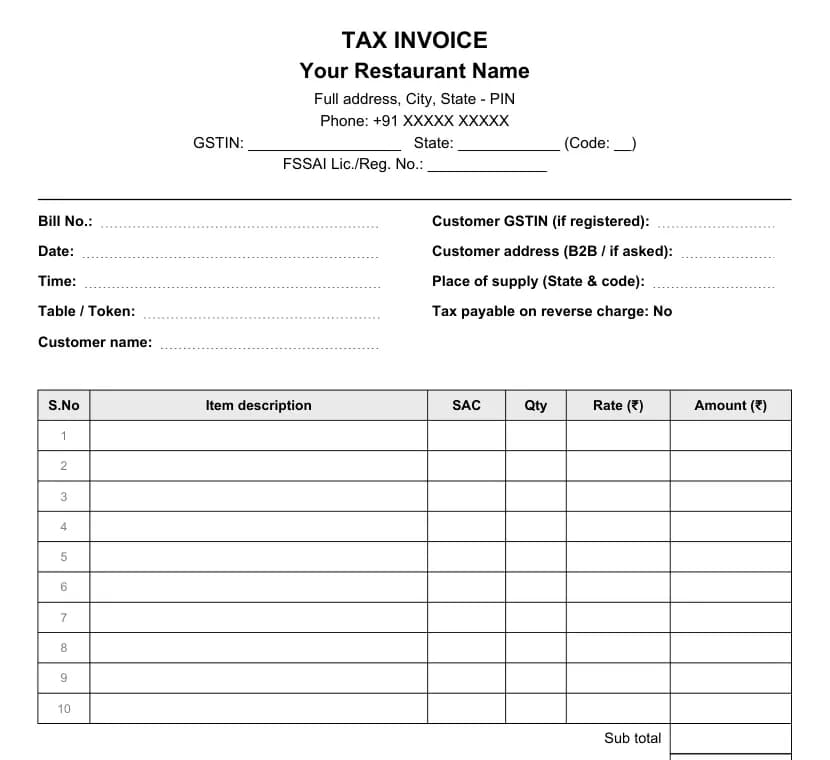
GST restaurant bill (tax invoice)
For GST-registered restaurants charging CGST + SGST (5%, or 18% in specified hotels).
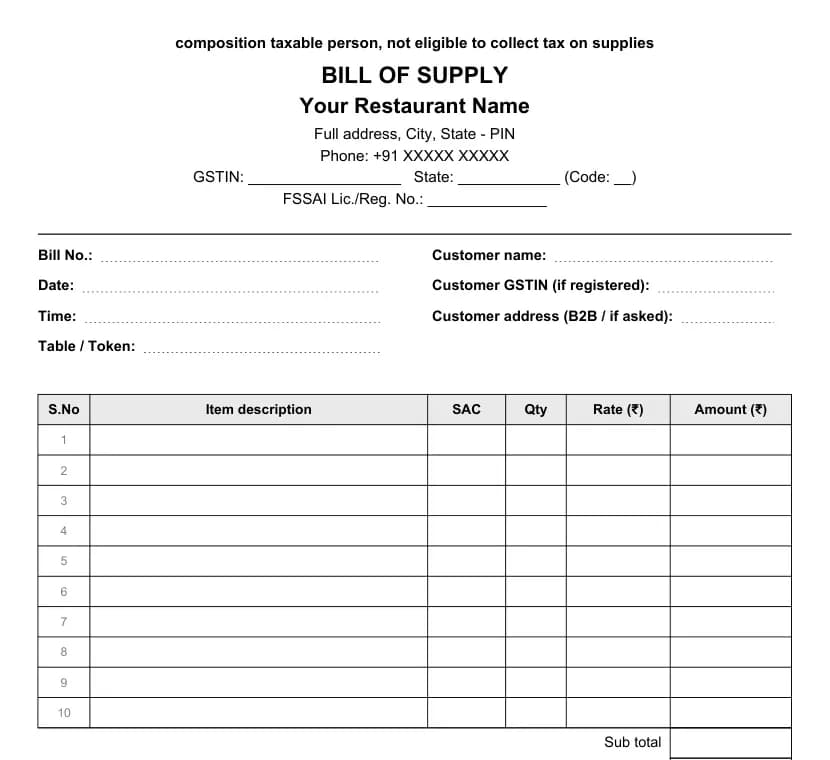
Bill of supply (composition scheme)
For restaurants registered under the composition scheme. No GST is charged on the bill.
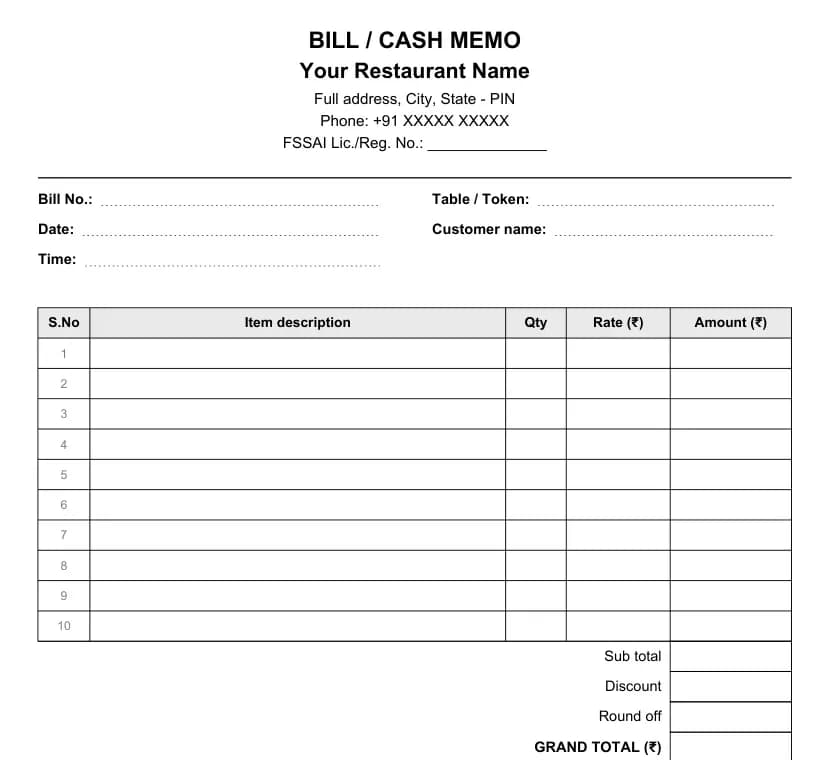
Word and PDF files are blank forms for typing or printing. The Excel files contain three sample items so you can see the formulas working — overwrite them with your own dishes.
Ordering stock from a supplier? Use the free purchase order format with GST. Run a supply business yourself? Billzova Trade also has a free delivery challan format, quotation format and credit note format in Excel.
Sample GST restaurant bill
Here is how the numbers work on a 5% GST bill. GST is worked out on the taxable value — the item total after any discount — and split equally into CGST and SGST because a restaurant meal is an intra-state supply.
Rounding the final amount to the nearest rupee is common practice; show the round-off as its own line so the bill still adds up.
The same layout works for an 18% hotel restaurant bill — change both rates to 9%.
TAX INVOICE
Your Restaurant Name
Address · Phone · GSTIN · FSSAI No.
Tax payable on reverse charge: No
How to make a restaurant bill
Six steps, whether you write it by hand, fill a template or print it from a POS.
- 1
Pick the right format. Registered for GST → tax invoice. On the composition scheme → bill of supply. Not registered → bill without GST (cash memo).
- 2
Fill your details once. Restaurant name, address and phone, your 14-digit FSSAI number, and your GSTIN if you are registered.
- 3
Number and date the bill. Give it the next serial number in the series (unique in the financial year), the date, and the time, table or token if you use them.
- 4
List what was served. Each item with quantity, rate and amount. Apply any discount to get the taxable value.
- 5
Add GST on the taxable value. For most restaurants 2.5% CGST + 2.5% SGST. Round the total to the nearest rupee on its own “Round off” line.
- 6
Write the total and keep a copy. Grand total and payment mode (cash, UPI, card). Keep a copy of every bill for your records and GST returns.
Restaurant bill format by order type
The same bill works for every order type — only a few details change.
Dine-in
Add the table number (and covers if you track them). One bill per table, or one per guest if they pay separately.
Takeaway / parcel
Write “Takeaway” or the token number in place of a table. For a standalone restaurant the GST rate is the same 5% as dine-in.
Your own delivery (phone, website, QR)
You bill these yourself, exactly like a dine-in or takeaway bill. Add the customer’s name, phone and delivery address.
Swiggy and Zomato orders
Since 1 January 2022 the app pays the GST on food ordered through it (section 9(5), CBIC Circular 167/23/2021-GST) — don’t charge GST on those orders again. Ask your CA how to show app orders in your returns.
What a restaurant bill must contain
Which bill you issue depends on your GST status. A registered restaurant issues a tax invoice; a composition restaurant issues a bill of supply; an unregistered eatery issues a plain bill.
GST tax invoice
CGST Rules, Rule 46
- • Your name, address and GSTIN
- • Consecutive bill number, max 16 characters, unique in the financial year
- • Date of issue
- • Customer name, address and GSTIN if they are registered (B2B)
- • HSN/SAC (see the turnover rule below)
- • Description, quantity and value of each item
- • Taxable value after discount
- • CGST and SGST rate and amount
- • Place of supply with state name, for inter-state supplies
- • Whether tax is payable on reverse charge
- • Signature (not needed on an electronic invoice)
Bill of supply (composition)
CGST Rules, Rules 49 and 5(1)(f)
- • At the top: “composition taxable person, not eligible to collect tax on supplies”
- • Your name, address and GSTIN
- • Consecutive bill number and date
- • Customer name and address, and GSTIN if registered
- • HSN/SAC (same turnover rule)
- • Description of items and value after discount
- • Signature
- • No CGST/SGST lines — a composition restaurant can’t collect tax
Bill without GST
Not registered for GST
- • Your restaurant name, address and phone
- • FSSAI licence/registration number
- • Bill number, date and time
- • Items, quantity, rate and amount
- • Total (and round-off if you round)
- • No GSTIN and no GST — charging GST without registration isn’t allowed
For every food business: FSSAI has required the 14-digit FSSAI licence or registration number on bills and cash memos since 1 October 2021. HSN/SAC: under Notification 78/2020-Central Tax, a 4-digit code is mandatory on B2B invoices up to ₹5 crore turnover (optional on bills to unregistered customers), and a 6-digit code is needed on all invoices above ₹5 crore. Restaurant service is SAC 996331.
Restaurant GST rate: 5% or 18%?
| Type of restaurant | GST on the bill | Input tax credit | Bill type |
|---|---|---|---|
| Standalone restaurant, café, dhaba, QSR, takeaway or delivery | 5% (2.5% + 2.5%) | Not allowed | Tax invoice |
| Restaurant in a hotel where any room’s value of supply exceeded ₹7,500/day in the previous financial year | 18% (9% + 9%) | Allowed | Tax invoice |
| Composition-scheme restaurant | None charged | Not allowed | Bill of supply; pays 5% of turnover itself |
| Not registered for GST | None | — | Simple bill / cash memo |
What changed in April 2025: the GST Council (55th meeting, 21 December 2024) dropped the old “declared tariff” test. From 1 April 2025, whether a hotel restaurant charges 18% depends on the actual value of any room supplied in the previous financial year (above ₹7,500 → 18% with credit; otherwise 5% without credit). Hotels can also choose to pay 18% with credit.
Common restaurant billing mistakes
Charging GST without a GSTIN. If you are not registered, you cannot add GST. Use the bill-without-GST format.
Composition restaurants showing CGST/SGST. A composition restaurant must issue a bill of supply with the composition line at the top — never a tax invoice with tax.
Breaks or repeats in bill numbers. Rule 46 needs a consecutive serial number unique in the financial year. Don’t restart the series mid-year or reuse cancelled numbers; mark a cancelled bill as cancelled.
Tax worked out before the discount. GST is calculated on the taxable value — after the discount — not on the menu total.
Adding service charge automatically. Under the CCPA’s 2022 guidelines, upheld by the Delhi High Court in March 2025, service charge must be optional and cannot be added by default. Restaurant associations have appealed that ruling, so check the latest position with your association or CA.
Missing FSSAI number. Print your 14-digit FSSAI licence or registration number on every bill.
Wrong rate for the premises. Most restaurants charge 5%. Only restaurants in hotels covered by the specified-premises rule charge 18%.
Tired of filling bills by hand?
billzova prints these bills automatically from your POS — ₹399/month, 30-day free trial. Each bill gets the next number automatically, CGST and SGST are worked out on every bill, and the same order also prints the KOT for the kitchen.
- Prints “TAX INVOICE” with your GSTIN and CGST/SGST lines
- Composition scheme? It prints a “BILL OF SUPPLY” with your GSTIN, the composition line at the top and no GST
- Not registered? Turn GST off and it prints a plain “BILL” with no GSTIN or tax
- FSSAI number on the bill, 58 mm / 80 mm thermal or A4
- GSTR-1 and GSTR-3B data with Excel export for your CA
Know before you switch: billzova does not print an HSN/SAC code per item yet. If your turnover means you must show SAC codes on your bills, keep using a template like the ones above for those bills, or ask us first.
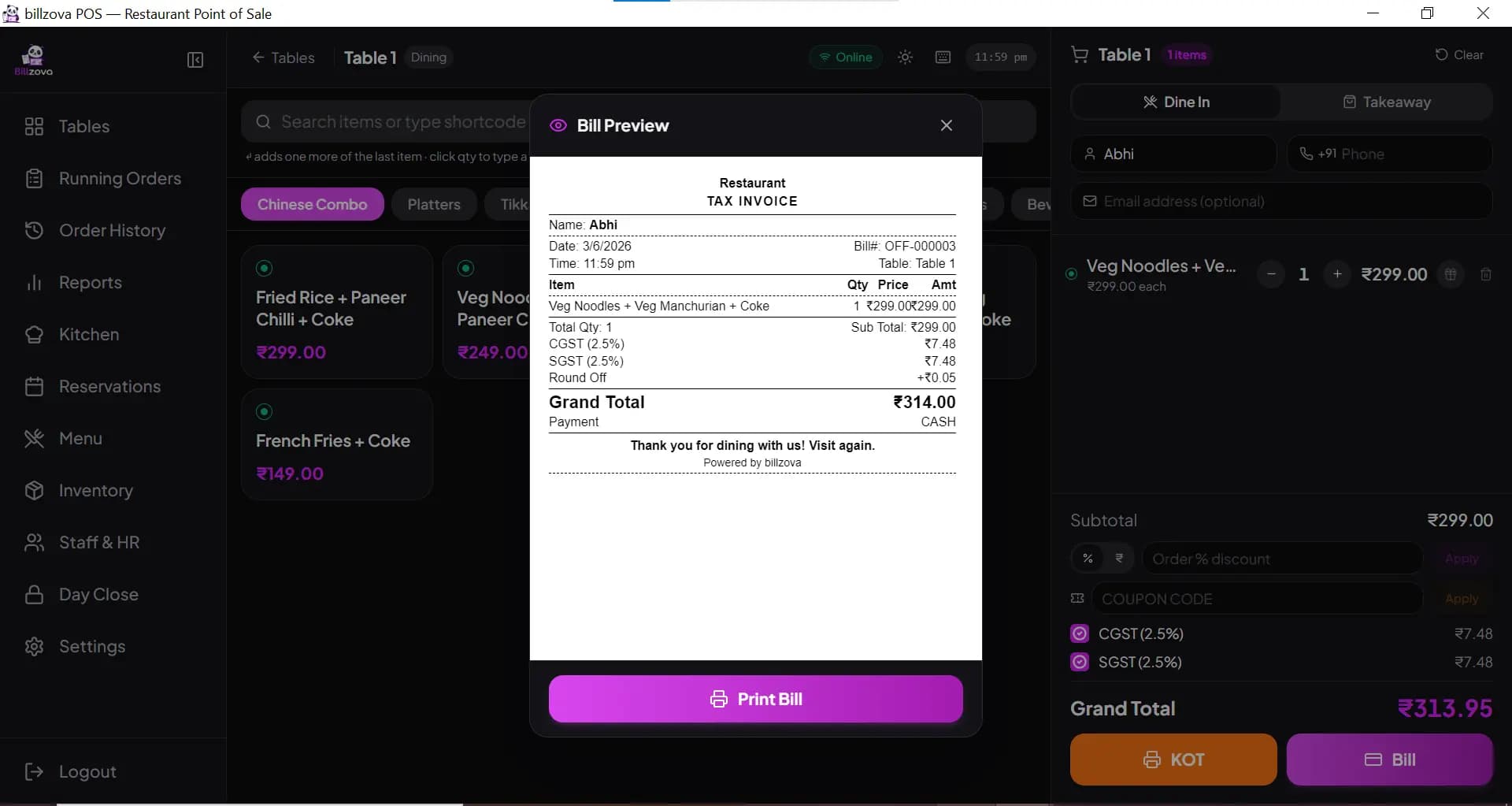
A real bill preview in the billzova Windows app
Restaurant bill format — FAQ
What is the GST rate on a restaurant bill?
For most restaurants it is 5% — 2.5% CGST plus 2.5% SGST — and the restaurant cannot claim input tax credit. Restaurants inside hotels where any room was supplied at a value above ₹7,500 per day in the previous financial year charge 18% (9% + 9%) and can claim input tax credit. Since 1 April 2025 that test uses the actual room value, not the old “declared tariff”.
What must a GST restaurant bill contain?
Under Rule 46 of the CGST Rules: your name, address and GSTIN; a consecutive bill number (up to 16 characters, unique in the financial year); the date; the customer’s name, address and GSTIN if they are registered; HSN/SAC; a description of each item; quantity; value; taxable value after discount; the CGST and SGST rate and amount; place of supply for inter-state supplies; whether tax is on reverse charge; and a signature (not needed on an electronic invoice).
Can a composition restaurant charge GST on the bill?
No. A composition restaurant pays tax on its turnover (2.5% CGST + 2.5% SGST) from its own pocket and must issue a bill of supply, not a tax invoice. Rule 5(1)(f) requires the words “composition taxable person, not eligible to collect tax on supplies” at the top of the bill.
Do I need to show the SAC code on a restaurant bill?
It depends on your turnover. Under Notification 78/2020-Central Tax, businesses with up to ₹5 crore turnover in the previous year must show a 4-digit code on B2B invoices, and it is optional on bills to unregistered customers. Above ₹5 crore, a 6-digit code is needed on all tax invoices. The restaurant service SAC is 996331 (group 99633, heading 9963). Check with your CA for your case.
What should a restaurant bill without GST look like?
A restaurant that is not registered for GST must not show a GSTIN or charge GST. A simple bill or cash memo with your name, address, FSSAI number, bill number, date, items, quantity, rate, amount and total is enough. Our “bill without GST” template has exactly these fields.
Is a hotel bill format different from a restaurant bill format?
For food, no — a hotel restaurant uses the same tax invoice, just at 18% (9% + 9%) if the hotel is in the specified-premises bracket. Room charges are a separate supply with their own rate and SAC, so they are often billed on a separate invoice. Our templates cover the food bill.
Do the Excel templates calculate totals automatically?
Yes. Type the quantity and rate and the line amount, sub total, taxable value, CGST, SGST, round off and grand total update by themselves. The CGST and SGST rate cells are set to 2.5% and can be changed to 9% for 18% GST.
Must the FSSAI licence number be on the bill?
Yes. Since 1 October 2021, FSSAI requires food businesses to print their 14-digit FSSAI licence or registration number on bills and cash memos. Every template here has a line for it.
How do I make a restaurant bill?
Pick the format that matches your GST status, fill in your name, address, FSSAI number and GSTIN (if registered), give the bill the next serial number and the date, list each item with quantity, rate and amount, apply any discount, work out GST on the amount after discount, round off on its own line, and write the grand total and payment mode. Keep a copy of every bill for your records and GST returns.
Is a restaurant bill the same as a receipt?
Not quite. A bill states what was supplied and the amount due — for a GST-registered restaurant it is a tax invoice, and for a composition restaurant a bill of supply. A receipt confirms that the money was received. At most restaurants the guest pays straight away, so one printed bill does both jobs; writing the payment mode (cash, UPI or card) on it records the payment.
Do I add GST to Swiggy and Zomato orders?
No. Since 1 January 2022, restaurant service ordered through an e-commerce operator such as Swiggy or Zomato is taxed under section 9(5) of the CGST Act: the app pays the GST on the food, even for restaurants that are not registered (CBIC Circular 167/23/2021-GST). Orders from your own counter, phone, website or QR menu are billed by you as usual. Ask your CA how to show app orders in your returns.
Which bill format should a dhaba use?
The same rules as any standalone restaurant. A dhaba that is not registered for GST uses the bill without GST (a cash memo) with its FSSAI number. A registered dhaba issues a 5% tax invoice (2.5% CGST + 2.5% SGST), or a bill of supply if it is on the composition scheme.
Sources
- CGST Rules, Rule 46 — Tax invoice (CBIC)
- CGST Rules, Rule 49 — Bill of supply (CBIC)
- CGST Rules, Rule 5 — Conditions for composition (CBIC)
- CGST Rules, Rule 7 — Composition rates (CBIC)
- 55th GST Council press release, 21 Dec 2024 — restaurants in hotels (CBIC)
- Notification 78/2020-Central Tax — HSN digits on invoices (GST Council)
- Circular 167/23/2021-GST — restaurant service through e-commerce operators (GST Council)
Checked on 28 October 2026. GST rules change — confirm with your CA before relying on them.