Offline vs Cloud POS Software: Which Is Right for Your Restaurant?
Offline vs Cloud POS Software: Which Is Right for Your Restaurant?
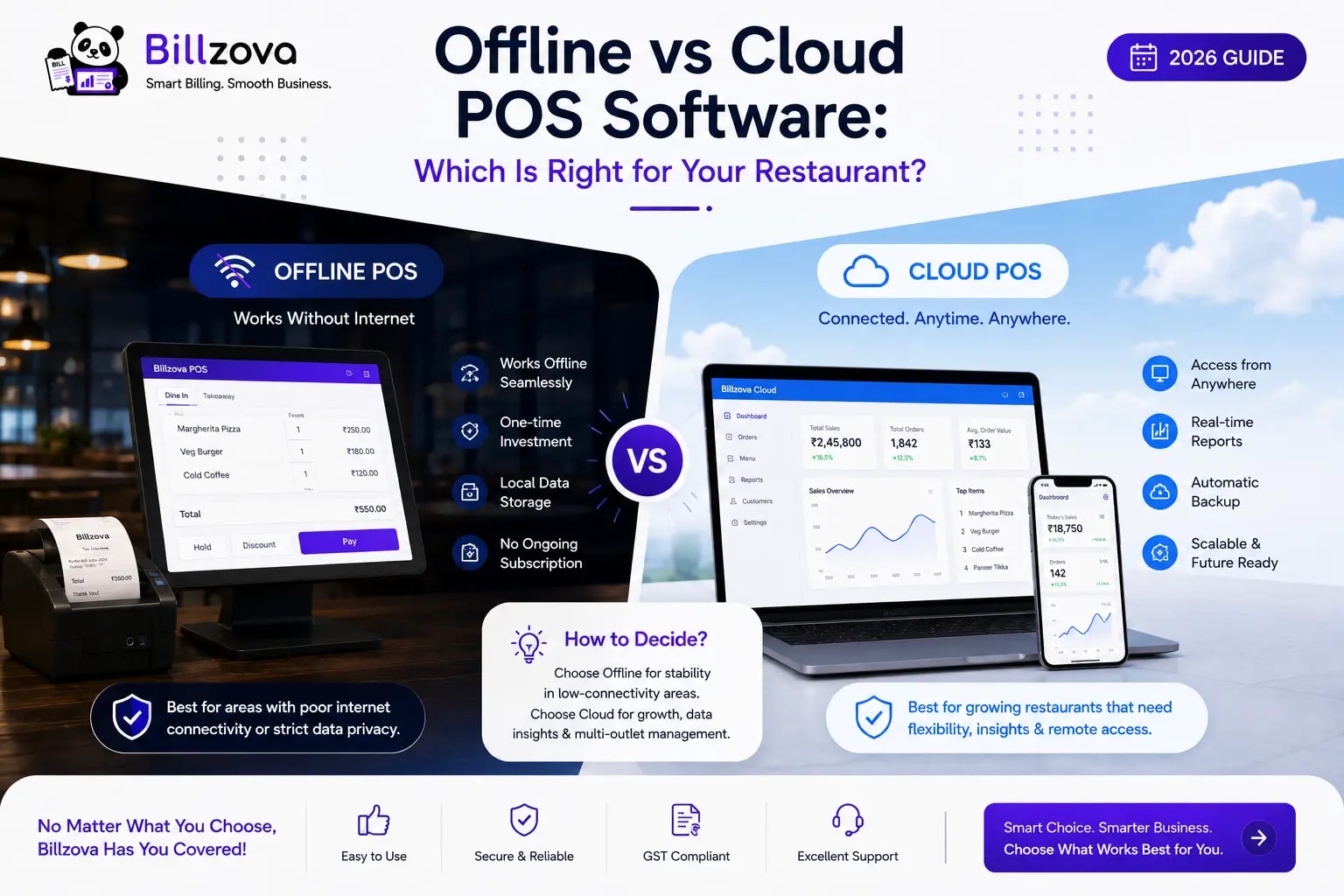
The offline vs cloud POS software decision rarely gets the attention it deserves during a software evaluation, because it sounds like a technical detail rather than a business-critical choice. It isn't a technical footnote — it's the single factor most likely to determine whether your restaurant keeps billing during a power cut or a busy-hour connectivity drop, both routine occurrences across much of India.
This guide explains exactly how each architecture works under the hood, the real trade-offs involved, and gives you a practical way to decide which fits your specific restaurant and location — rather than treating "cloud" as automatically modern and "offline" as automatically outdated, which is a common but misleading framing.
Table of Contents
- What "Offline" and "Cloud" Actually Mean for POS Software
- How Offline-First Architecture Actually Works
- How Cloud-Only Architecture Actually Works
- Side-by-Side Comparison
- Pros and Cons of Offline-First POS
- Pros and Cons of Cloud-Only POS
- The Hybrid Approach: Best of Both
- How to Actually Test This Before Buying
- Which Architecture Fits Which Location and Restaurant Type
- Common Mistakes When Evaluating This
- Real-World Examples
- Future Outlook
- Frequently Asked Questions
- Conclusion
What "Offline" and "Cloud" Actually Mean for POS Software
These terms get used loosely in marketing, so it's worth being precise. Cloud-only POS software requires an active internet connection to process core functions — billing, KOT generation, and often even basic order entry — because the logic runs on a remote server, not on the device in front of your staff. Offline-first POS software runs the core billing and order logic locally on the device itself, with cloud connectivity used for syncing data (reports, multi-branch visibility) rather than for the transaction itself.
The distinction matters because many systems marketed as having "offline mode" actually mean a degraded backup state — limited functionality, delayed KOT printing, or features that simply stop working — rather than full, unrestricted operation without a connection. Understanding which kind of "offline" a vendor actually means is the single most important question to ask during evaluation.
How Offline-First Architecture Actually Works
In a genuinely offline-first system, when a staff member enters an order, the billing calculation, GST invoice generation, and KOT creation all happen using logic and data stored locally on the device — no round-trip to a server required. The transaction is recorded in a local database immediately. Separately, a background sync process pushes that data to the cloud whenever a connection is available, which is what powers remote reporting, multi-branch dashboards, and backup.
The practical result: a staff member taking an order during an internet outage experiences no difference from normal operation. Billing completes, the KOT prints, the customer gets their invoice — and the data syncs automatically the moment connectivity returns, with no manual reconciliation step required afterward.
How Cloud-Only Architecture Actually Works
In a cloud-only system, the order entry screen typically sends the transaction to a remote server, which calculates the bill, generates the invoice, and sends back a confirmation — all requiring a live connection for each step. Some cloud-only systems implement a basic local cache that lets you queue orders during a brief outage, syncing them once reconnected, but this is meaningfully different from full offline operation: KOT printing, real-time inventory deduction, and GST invoice generation may all be delayed or unavailable until the connection returns.
This architecture isn't inherently bad — it can mean lighter hardware requirements, easier updates (since logic lives centrally), and simpler multi-device setups. The trade-off is a direct dependency on connectivity for actual operation, which becomes a real cost the moment that connectivity isn't available.
Side-by-Side Comparison
| Factor | Offline-First | Cloud-Only |
|---|---|---|
| Billing during internet outage | Continues normally | Stops or severely limited |
| KOT printing without internet | Works as normal | Often delayed or fails |
| Hardware requirement | Usually a dedicated device (e.g. Windows desktop) | Lighter — often any browser/tablet |
| Data sync | Background, automatic, on reconnect | Real-time, requires constant connection |
| Update/maintenance model | Local app updates needed periodically | Centrally updated, no local install changes |
| Best suited for | Variable power/connectivity environments (most of India) | Locations with very reliable, fast internet |
Pros and Cons of Offline-First POS
Pros: Billing never stops due to connectivity; consistent performance regardless of network conditions; no lost sales during outages; works reliably in areas with known power or internet variability.
Cons: Typically requires a dedicated device rather than running on any browser; local app updates need to be installed periodically rather than happening automatically server-side.
Pros and Cons of Cloud-Only POS
Pros: Can run on lighter, more flexible hardware; centrally managed updates; sometimes simpler initial multi-device setup.
Cons: Billing depends directly on connectivity; outages translate immediately to operational disruption; "offline mode" claims often mean degraded rather than full functionality.
The Hybrid Approach: Best of Both
The strongest restaurant POS systems combine offline-first local operation for the core transaction flow with cloud sync for everything that benefits from centralization — multi-branch reporting, remote dashboard access, and backup. This is the architecture behind Billzova's restaurant POS software: a Windows desktop app handles billing, KOT, and GST invoicing fully offline, while a web dashboard gives owners remote visibility once data syncs.
This combination avoids the core weakness of cloud-only systems (connectivity dependency for basic operation) while still providing the remote-management convenience that pure offline systems, used in isolation across multiple locations, would lack.
How to Actually Test This Before Buying
- Ask the vendor to demonstrate billing with the internet actually disconnected, not just describe what happens.
- Confirm what specifically works during the outage — billing, KOT printing, GST invoicing — versus what's delayed or unavailable.
- Ask how the sync process works once reconnected — is it automatic, or does it require manual intervention?
- Check whether multi-branch reporting still works during a single branch's outage, or whether it depends on every location being online simultaneously.
- Run a real trial in your actual location, where you know your specific connectivity patterns, rather than relying solely on a vendor demo in a different environment.
Which Architecture Fits Which Location and Restaurant Type
| Situation | Recommended Architecture |
|---|---|
| Restaurant in a city with frequent power cuts | Offline-first, strongly preferred |
| Restaurant in a dense commercial area with peak-hour congestion | Offline-first, strongly preferred |
| Single outlet with very reliable, redundant power/internet | Either can work; offline-first still removes risk at no real downside |
| Multi-branch chain needing consolidated reporting | Hybrid (offline-first per branch + cloud dashboard) |
| Cloud kitchen dependent on continuous aggregator connectivity anyway | Hybrid, with strong emphasis on local KOT reliability |
Common Mistakes When Evaluating This
- Accepting "works offline" as a claim without seeing it demonstrated live.
- Assuming cloud-based automatically means more modern or better, without evaluating actual reliability trade-offs for your specific location.
- Not asking what specifically degrades during an outage in a system with partial offline support.
- Testing only during a quiet demo period, rather than under conditions resembling your actual peak-hour load.
Real-World Examples
A restaurant near Chandni Chowk, Delhi experienced regular connectivity congestion during peak evening hours in a dense commercial market. Switching to offline-first billing eliminated the disruption entirely — orders and GST invoices continued generating normally regardless of network conditions during the busiest period of service.
A mithai shop in Kanpur's old city area dealt with frequent power cuts that previously stopped their cloud-based billing system mid-transaction. An offline-first system kept billing running through these outages, syncing automatically once power returned, with no manual reconciliation needed afterward.
A multi-outlet chain across Delhi NCR needed both reliable per-branch billing and a consolidated view across locations. A hybrid architecture — offline-first billing per branch, with cloud-synced multi-branch reporting — gave them both without the connectivity dependency a pure cloud system would have introduced at each location.
Future Outlook
- Hybrid architectures becoming the default expectation rather than a premium differentiator, as more buyers understand the real trade-offs.
- Improving but still uneven connectivity infrastructure across India keeping offline reliability operationally relevant for the foreseeable future.
- Greater scrutiny of "offline mode" marketing claims, as more owners have direct experience with the gap between marketed and actual offline functionality.
Frequently Asked Questions
What's the real difference between offline and cloud POS software?
Offline-first systems run core billing and KOT logic locally on the device, requiring no connection for transactions. Cloud-only systems depend on a live connection to a remote server for the same functions, syncing data centrally in real time.
Is offline POS software better than cloud POS software?
For most Indian restaurants, yes, given variable power and internet reliability — offline-first keeps billing working through outages a cloud-only system can't handle. Locations with extremely reliable connectivity have more flexibility either way.
Can a POS system be both offline and cloud-connected?
Yes — this hybrid approach (offline-first local operation plus cloud sync for reporting and remote access) is generally the strongest architecture, combining reliability with remote-management convenience.
How do I know if "offline mode" claims are real?
Ask for it to be demonstrated live, with the internet actually disconnected, rather than accepting a written or verbal claim. Confirm specifically what continues working — billing, KOT printing, GST invoicing — versus what's delayed or unavailable.
Does offline POS software work for multi-branch restaurants?
Yes, in a hybrid setup — each branch operates offline-first for its own billing, while data syncs to a cloud dashboard for consolidated multi-branch reporting once connectivity is available.
What happens to my data during an internet outage with offline-first software?
It's stored locally and syncs automatically to the cloud once your connection returns — no manual reconciliation step should be required if the system is built correctly.
Is cloud-only POS software ever the better choice?
It can be, particularly where hardware flexibility matters more than connectivity risk, or in locations with genuinely reliable, redundant internet infrastructure. It's a trade-off, not a universally inferior option — but the connectivity risk should be evaluated honestly for your specific location.
Does offline-first POS software require special hardware?
Typically a dedicated device, often a Windows desktop, rather than running on any generic browser or tablet — this is part of the trade-off for genuine offline reliability.
How does Billzova handle offline vs cloud architecture?
Billzova uses a hybrid approach — a Windows desktop app for fully offline billing, KOT, and GST invoicing, combined with a web dashboard for remote reporting once data syncs.
Can I test offline functionality before committing to a POS system?
Yes, and you should — request a live demonstration with the internet disconnected as part of your evaluation. Billzova's demo includes this specifically.
Does a cloud kitchen need offline-first POS, given it already depends on internet for aggregator orders?
Yes — even though aggregator connectivity is unavoidable, the actual billing, KOT generation, and internal kitchen workflow benefit from offline reliability, since a connectivity drop shouldn't also stall internal order processing and routing.
What's the biggest risk of choosing cloud-only POS software in India?
Direct exposure to lost sales and operational disruption during power cuts or connectivity drops, which remain a routine occurrence in many parts of India rather than a rare edge case.
Conclusion
The offline vs cloud POS software decision isn't a minor technical detail — it's a direct determinant of whether your restaurant keeps billing through the outages that are a routine part of operating in most of India. A hybrid architecture, combining offline-first local reliability with cloud-synced remote reporting, generally offers the strongest combination of both worlds, and it's worth testing any vendor's offline claims live rather than accepting them at face value.
If you want to see this architecture in practice, Billzova's restaurant POS software bills, prints KOTs, and generates GST invoices fully offline, with a synced web dashboard for remote visibility. Start a free first month, book a live demo to see the offline test directly, or talk to our team about your specific location's connectivity.
Billzova Team
Restaurant POS & Billing Experts
We build Billzova — GST billing, KOT, offline mode, inventory and reports for Indian restaurants. This team writes from what we see helping real restaurants bill faster every day.
Run your restaurant on billzova
GST billing, KOT, offline mode, inventory & reports in one app. ₹399/month — first month free.