How to Set Up a Restaurant Referral Program That Actually Pays Out
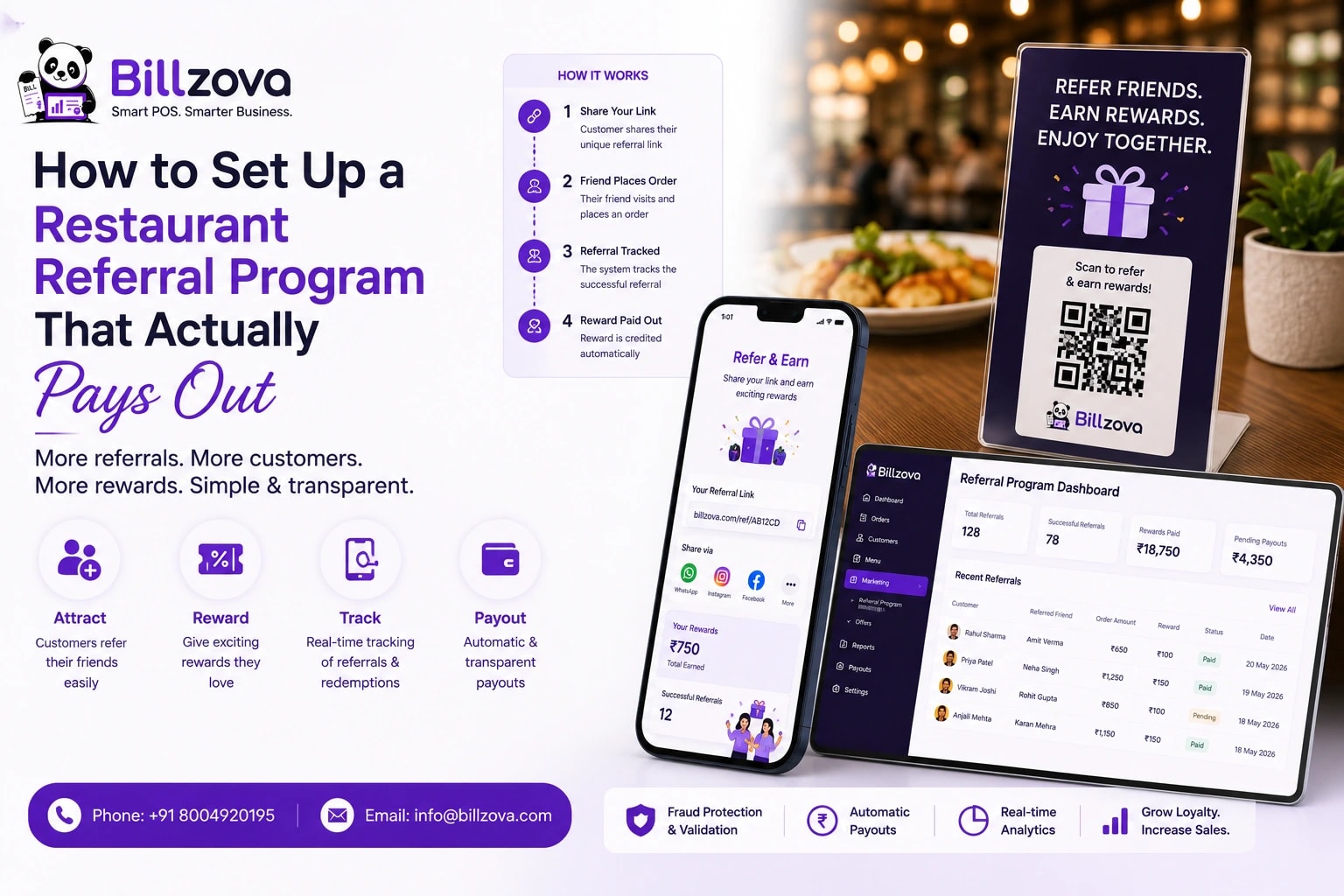
"Shivam said he'll send us customers, and we agreed to give him 5%." It's one of the most common arrangements in Indian restaurants, and one of the least formally tracked. A staff member, a local delivery rider, a nearby hotel concierge, a friend who runs a corporate office nearby — someone offers to send business your way in exchange for a cut, you agree verbally, and then the actual tracking of who they referred, how much those orders came to, and what you owe them happens entirely in someone's memory, or a WhatsApp thread that gets harder to reconstruct with every passing week.
This arrangement is genuinely valuable when it works — word-of-mouth referral is one of the cheapest, highest-trust ways a restaurant grows. The problem isn't the idea. It's that most restaurants never build any real infrastructure around it, and an arrangement that depends entirely on two people's memory and goodwill tends to quietly deteriorate the moment either side starts to doubt the numbers.
Charlie Munger
Investor, Vice Chairman of Berkshire Hathaway
That's the entire logic of a referral program in one sentence. A referrer who's confident they'll be paid accurately keeps sending you customers. A referrer who has to ask, chase, and eventually just wonder whether they're being shortchanged stops bothering — not necessarily because you actually shorted them, but because an unverifiable arrangement erodes trust on its own, regardless of anyone's actual intentions. This guide is about building the second scenario into the first: a referral program with real tracking, on both sides, instead of one built entirely on trust and memory.
Why Most Restaurant Referral Deals Fall Apart
It's rarely dishonesty that kills these arrangements. It's ambiguity. A verbal 5% deal has no record of which specific orders counted, no shared way to verify the total, and no answer to an obvious question that eventually comes up: does the referrer get credited only for a customer's first visit, or every time that customer comes back? Two reasonable people can disagree about that in good faith, precisely because nothing was ever written down.
The failure mode usually looks the same regardless of restaurant: the arrangement works fine for the first month, because both sides are paying close attention. By month three, the restaurant owner is busy, the referrer stops getting paid promptly, a conversation about "how much do I actually owe you" becomes awkward because neither side has real numbers, and the whole arrangement quietly ends — not from a dramatic falling out, but from friction that a proper tracking system would have prevented from ever building up.
What a Real Referral Program Actually Needs
Stripped down to essentials, a referral arrangement that actually survives past the first enthusiastic month needs four things, and a notebook or a verbal agreement genuinely can't provide any of them reliably.
Checklist
- A clear identity for each referrer — not just a name, but something that can be linked to specific orders
- An agreed rate that's recorded somewhere both sides can see, not just remembered
- A way to attribute a specific order to a specific referrer at the moment it's billed
- Visibility for the referrer into what they're actually owed, without having to ask
Every one of these is solvable with a spreadsheet if you're disciplined about it — but "if you're disciplined about it, every single day, for as long as the arrangement runs" is exactly the condition that tends to fail under the ordinary pressure of running a restaurant. The value of building this into your billing system directly isn't that it's impossible to do by hand; it's that it stops depending on anyone remembering to do it.
Percentage vs Fixed Commission: Which Fits Your Situation
The two most common structures are a percentage of the bill, or a flat fixed amount per order — and the right choice depends on what you're actually trying to reward.
| Percentage of Bill | Fixed Amount | |
|---|---|---|
| How it scales | Rewards bigger orders more | Same payout regardless of order size |
| Best fit for | Referrers who influence what gets ordered, not just whether | Referrers who simply bring in a customer or a booking |
| Predictability for you | Cost scales with revenue — always proportional | Easier to budget per referral, regardless of ticket size |
| Predictability for them | Payout varies order to order | Know exactly what each referral is worth upfront |
| Common real-world use | Staff referrals, ongoing partnerships with regular volume | One-off referrals, delivery riders, simple "bring a customer" deals |
Neither is objectively better — they optimize for different things. A percentage arrangement makes sense when you want the referrer's incentive to track your actual revenue from that relationship. A fixed amount makes sense when the referral itself, not the size of any particular order, is the thing you're paying for. Some restaurants use both simultaneously for different referrers, and there's no reason not to — a delivery rider bringing in occasional walk-ins might make more sense as a small fixed amount, while a staff member actively upselling to people they refer might make more sense as a percentage.
Why Referral Commission Should Never Touch the Customer's Bill
This is worth stating plainly because it's a common instinct to get wrong: a referral commission is an internal arrangement between you and the referrer. It should never appear on the customer's invoice, never affect the price the customer pays, and never require the customer to know anything about it at all.
Warning
Done correctly, a customer whose order happens to be linked to a referral partner receives an identical bill to a customer whose isn't — same tax calculation, same total, same invoice format. The only difference lives in your own internal records and the referrer's own dashboard, never in anything the customer sees or signs.
The Moment That Actually Matters: When Commission Gets Calculated
Here's a subtlety that trips up hand-tracked arrangements specifically: if a referrer's rate changes — you renegotiate from 5% to 7%, say — what happens to orders that were already billed under the old rate?
The correct answer, and the one worth building into any system you use, is that commission gets calculated and locked in at the exact moment an order is billed, using whatever rate was active then. A later rate change should only ever apply going forward, never retroactively rewrite what a past order was worth. Without this, a rate renegotiation becomes genuinely messy — do you recalculate every historical order at the new rate? Leave old ones ambiguous? A hand-kept spreadsheet has no natural answer to this question, which is exactly the kind of dispute that damages trust on both sides months after the actual change was agreed.
What Happens When a Referred Customer Comes Back
This is the single most common point of disagreement in informal referral arrangements, and it's worth deciding explicitly rather than leaving it ambiguous. Say a referrer brings you a new customer in January. That customer becomes a regular, visiting monthly through the rest of the year. Does the referrer get credited for every one of those later visits, or only the first?
There's no universally correct answer — reasonable restaurants land on either side. But whichever you choose, it needs to be a real, applied rule, not something re-decided in conversation every time it comes up. A system that automatically keeps crediting a referrer for a customer's future visits, once that link is established, removes the need to re-litigate this decision every single time a repeat customer places an order — and removes an entire category of "wait, does this one count?" disputes that otherwise recur indefinitely.
Referral Commission and Customer Loyalty Work Well Together
There's a natural overlap between referral tracking and how you already think about repeat customers and loyalty, covered in more depth in our restaurant CRM guide. A referred customer who becomes a genuine regular is exactly the kind of high-value relationship a CRM strategy is built to nurture — and the referral attribution sitting on that same customer record means you can see, at a glance, which of your acquisition channels are actually producing loyal repeat customers versus one-time visitors.
That combination — knowing not just who referred a customer, but whether that customer actually became a long-term regular — is more useful than either data point alone. A referrer who consistently sends you customers who visit once and never return is worth less to your business than one who sends you customers who become genuine regulars, even if the immediate order values look identical. Without connecting referral data to repeat-visit data, that distinction is invisible.
Giving Your Referral Partner Their Own Visibility
Almost every version of this arrangement that runs entirely on trust has the same structural weakness: the referrer has no way to verify what they're owed except taking the restaurant's word for it. That's not a comfortable position for anyone, and it's the single biggest reason these relationships sour over time even when nobody is actually being dishonest.
The fix isn't complicated in principle — give the referrer their own access to see exactly what's been attributed to them, updated in something close to real time, without needing to ask. A referrer who can check their own numbers independently doesn't need to trust your word; they can simply look. That single change — moving from "trust me" to "see for yourself" — does more to keep a referral relationship healthy long-term than any rate negotiation could.
Setting Rates That Are Fair to Both Sides
There's no universal "correct" referral rate — it depends heavily on your margins, your average order value, and how much genuine influence the referrer actually has over whether a customer chooses you. A few practical anchors help avoid setting a rate that's unsustainable for you or insulting to them.
Best Practice
- Calculate the rate against your actual margin, not your revenue — a rate that looks small against the bill total can be large against your real profit
- Consider what the referrer is actually contributing — a passive mention is worth less than active, ongoing promotion
- Check what's typical in your specific local market or industry, if you can find out, rather than guessing blind
- Start conservatively and revisit the rate after a real trial period — it's far easier to raise a rate than to walk one back
- Put the agreed rate in writing somewhere both sides can refer back to, even if the relationship itself stays informal
A Referral Arrangement, Before and After Real Tracking
Concrete before-and-after makes the difference easier to picture. Take the Shivam scenario from the opening of this guide, played out both ways over six months.
Without real tracking: Shivam sends a handful of customers over the first month, and the restaurant owner pays him a rough estimate in cash, based on a mental tally. By month two, both sides are busier, and the "estimate" starts drifting — Shivam feels it's coming up short; the owner isn't sure either, since there's no real record to check against. By month four, Shivam has quietly stopped actively referring people, not out of any specific grievance, but because the arrangement stopped feeling worth the effort of tracking on his own side. Neither side ever has a real conversation about it — it just fades.
With real tracking: Shivam is registered with a 5% rate on the first day. Every order attributed to him is calculated automatically and visible in his own dashboard, in near real time. Three months in, he can see for himself that he's brought in ₹1,40,000 in orders and earned a specific, exact commission figure — no estimating, no asking. Because the number is never in question, there's nothing to quietly resent, and the relationship keeps running on the same terms it started with, because neither side ever had a reason to start doubting it.
The difference in outcome has nothing to do with either party's honesty in either scenario. It's entirely about whether the arrangement had a real, checkable record behind it, or nothing more solid than two people's separate, drifting impressions of how it was going.
Common Mistakes Restaurants Make With Referral Arrangements
Treating every referrer identically regardless of actual volume. A referrer sending you one customer a month and one sending you fifteen shouldn't necessarily be on the same terms — but many informal arrangements never revisit the original rate once it's set, even as the relationship's real value changes substantially.
Never actually reviewing the numbers. A referral program that's set up once and never checked again drifts — a referrer who stopped actually sending business six months ago might still be getting attributed to customers out of habit, or a genuinely valuable referrer might be under-credited because nobody's watching closely enough to notice.
Confusing this with a customer discount program. A referral commission rewards the person who brought the customer in. A loyalty discount rewards the customer themselves. They solve different problems and shouldn't be run as the same mechanism, even though both involve giving something away in exchange for business.
This Is Not the Same as Becoming a Billzova Partner
Worth a direct clarification, since the terminology overlaps: everything in this guide is about your restaurant paying your own referral partners — staff or outside contacts who send customers to you specifically. That's a completely different thing from becoming a Billzova partner yourself, which is a separate program where you'd earn commission from Billzova for referring other restaurants to sign up for the software. One is about growing your own restaurant's customer base; the other is about reselling Billzova. They share a word, not a mechanism.
How to Actually Set One Up
Checklist
- Decide, upfront, whether repeat visits from a referred customer should keep crediting the referrer
- Pick percentage or fixed commission based on what you're actually trying to reward
- Register each referrer with a real rate — not a vague verbal understanding
- Make sure the commission calculation never touches the customer-facing bill or invoice
- Give each referrer their own way to check what they're owed, rather than relying on you to report it
- Review the arrangement periodically — rates, volume, and whether it's still working for both sides
None of this requires elaborate infrastructure to get right — it requires treating a referral arrangement as a real, trackable business relationship rather than a favour based on trust alone. The restaurants that keep valuable referral relationships running for years, rather than watching them quietly fade after a few months, are almost always the ones that made tracking effortless enough that neither side ever had a reason to start wondering about the numbers.
Frequently Asked Questions
Do I have to pay referral commission to staff members, or only outside people?
Either, or both — a referral program can cover staff earning a cut for bringing in business just as easily as outside referrers like delivery agents or local partners. The mechanism works the same way regardless of who the referrer is.
Does referral commission show up on the customer's GST invoice?
No, and it shouldn't. It's a purely internal arrangement for your own reporting and the referrer's own visibility — the customer's bill is calculated exactly as it would be without any referral involved.
Should commission be calculated before or after tax?
Before tax — on the bill's subtotal, not the final GST-inclusive total. This keeps the commission tied to the actual value of what was sold, not inflated by tax that has nothing to do with the referral itself.
What if a referrer disputes how much they're owed?
This is exactly the scenario proper tracking is meant to prevent — if the referrer has their own independent visibility into what's been attributed to them, there's rarely a real dispute left to have, since both sides are looking at the same underlying numbers rather than one side's word against the other's.
Can one referrer work with more than one restaurant?
Yes, commonly — a delivery rider or local business contact might reasonably refer customers to several nearby restaurants they have a relationship with, each potentially at a different rate. There's no reason a referral identity needs to be exclusive to one restaurant.
Is a referral program worth setting up for a small, single-location restaurant?
If you already have informal referral relationships happening — and most restaurants do, even without calling it that — formalizing the tracking costs very little and removes a real source of friction. It's less about restaurant size and more about whether the relationship already exists in some form.
How is this different from billzova's food-court vendor commission?
Completely different arrangement. This guide covers a restaurant paying its own referral partners for bringing in customers. The food-court version is a restaurant-to-restaurant arrangement, where a food-court operator takes a cut of a vendor restaurant's sales — see our food courts & shared spaces guide for that one.
Can I end a referral arrangement if it stops working out?
Yes — a referral relationship should be revisable, not permanent by default. Ending or adjusting one is a normal part of managing it, and having real tracking in place makes that conversation easier, not harder, since both sides can look at the same data to understand why.
Do I need a written contract for a referral arrangement, or is tracking software enough?
Tracking software records the rate and the numbers, but it isn't a substitute for however formal an agreement you actually want with a given referrer — a simple written note of the agreed terms is worth having alongside the tracking, especially for larger or longer-term relationships.
The Bottom Line
A referral arrangement built on a handshake and good intentions can absolutely work — right up until either side starts to wonder whether the numbers are actually right. The fix isn't distrust; it's removing the need for trust to carry the whole arrangement in the first place, by making the numbers something both sides can actually see.
billzova's referral commission tracking handles exactly this: register a partner with a real rate, have commission calculated and locked in automatically the moment a bill settles, keep it completely off the customer's invoice, and give every partner their own login to see what they've earned — included standard at ₹399/month, with your first month free.
Billzova Team
Restaurant POS & Billing Experts
We build Billzova — GST billing, KOT, offline mode, inventory and reports for Indian restaurants. This team writes from what we see helping real restaurants bill faster every day.
Run your restaurant on billzova
GST billing, KOT, offline mode, inventory & reports in one app. ₹399/month — first month free.