Restaurant Staff Turnover: Why It Happens and How Better Systems Help Retain Staff
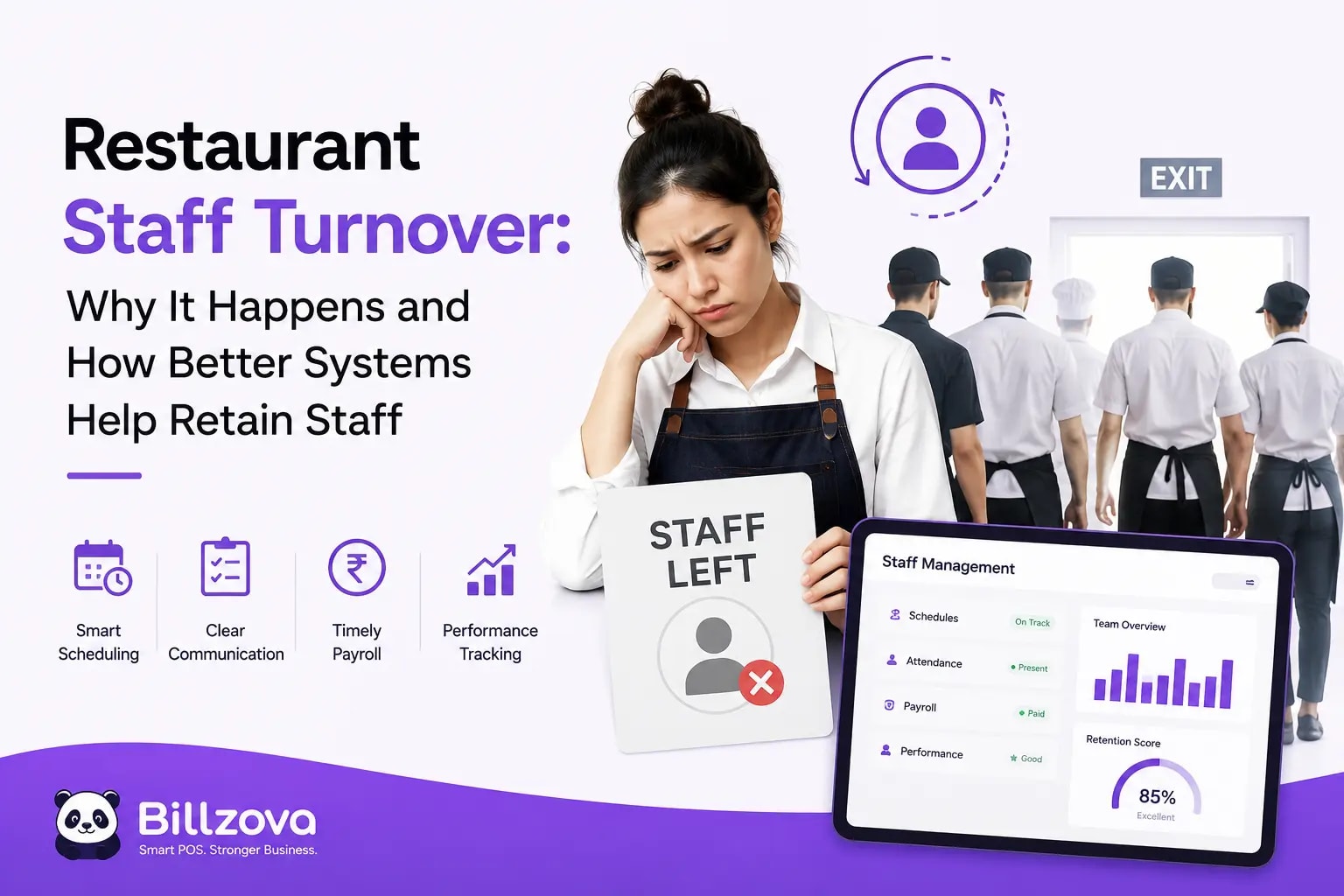
Ask any restaurant owner what keeps them up at night and staff turnover is somewhere near the top of nearly every list — not because it's a mystery, but because knowing exactly why staff leave doesn't automatically make it easy to fix. This guide is deliberately honest about that: turnover is fundamentally an HR and management challenge, not a software problem, and no POS system is going to fix low pay or a toxic kitchen culture. What a good system can genuinely do is remove some of the specific, avoidable friction that makes an already-difficult job harder than it needs to be — which matters, even if it isn't the whole answer on its own.
30-40%
Why Restaurant Staff Actually Leave
The honest list of reasons is fairly consistent across the industry, in India and globally, and worth naming plainly rather than dancing around: low or unpredictable pay relative to the physical demands of the work, long and irregular shifts that make work-life balance genuinely difficult, limited visibility into scheduling that makes personal planning hard, a lack of clear paths toward higher-paying or more senior roles, and — very often underestimated — poor day-to-day management, including a sense of being blamed unfairly for problems outside an individual staff member's control.
In India specifically, the picture has an added dimension: a genuine talent bottleneck, driven partly by migration toward metro cities and limited local training infrastructure for kitchen and service roles, means restaurants are often competing hard for the same limited pool of experienced staff — which gives staff more leverage to leave for marginally better pay or conditions elsewhere the moment their current job gets difficult. Attrition tends to run especially high for staff posted to smaller cities or Tier-2 locations, where the local hiring pool is thinner to begin with.
The Real Cost of Losing a Staff Member
Turnover's cost is usually underestimated because most of it is invisible on a P&L statement. Recruiting and training time, the productivity dip while a new hire gets up to speed, the institutional knowledge that walks out the door with an experienced staff member, and the service-quality inconsistency customers notice during a transition period are all real costs that don't show up as a single line item, which is exactly why they're so easy to underbudget for and so easy to dismiss as "just part of running a restaurant."
There's also a compounding effect worth naming directly: high turnover makes the remaining staff's jobs harder too, since a short-staffed or constantly-retraining team absorbs more pressure per person, which in turn makes those remaining staff more likely to leave as well. Turnover that isn't addressed tends to accelerate rather than stay flat.
Richard Branson
Founder, Virgin Group
What Actually Reduces Turnover — Being Honest About Limits
The most effective levers for reducing staff turnover are genuinely about pay, scheduling fairness, management culture, and real career progression — not software. Competitive, predictable pay; schedules set with enough notice that staff can plan their lives around them; a management style that treats mistakes as coaching opportunities rather than blame sessions; and a visible path from, say, kitchen helper to line cook to shift supervisor all address the root causes directly, in ways no system sitting on top of the business can substitute for.
Info
Where Systems Genuinely Help — Real, Specific Friction Points
With that honesty established, there are concrete, specific frictions in day-to-day restaurant operations that a well-built system does measurably reduce, even though it can't touch the bigger structural causes above.
Checklist
- Role-based access reduces trust friction — staff aren't wrongly accused of overstepping their role when permissions are clear and enforced automatically, rather than relying on informal trust that breaks down under pressure
- Switching off a login instantly on exit protects both the business and departing staff — no lingering access disputes, no awkward "did you remove their login" conversations weeks later
- Per-shift Z-reports give staff an objective record of their own session's cash and sales, protecting them from being unfairly blamed for a discrepancy that happened on someone else's shift
- Digital attendance removes disputes over hours worked — a searchable, exportable log settles pay disagreements with data instead of memory or a torn paper register
- A quick, individual login at the counter reduces the daily friction of a slow or confusing system, which matters more than it sounds like during a stressful rush shift
The Z-report point deserves particular emphasis because it's one of the least obvious retention-relevant features on this list: cash discrepancies are a genuine, recurring source of workplace conflict in restaurants, and when a shift's sales and cash are tied clearly to the specific staff member who worked it, an honest employee has an objective record protecting them from being blamed for someone else's shortfall. That's not a minor convenience — it's the kind of unfair-blame scenario that genuinely pushes good staff to quit, and it's directly preventable with the right system in place.
It's worth sitting with why this particular friction point matters so much more than it looks like it should on paper. Being wrongly suspected of dishonesty over money is a categorically different kind of workplace grievance than a scheduling inconvenience — it's personal, it's hard to disprove after the fact without records, and it tends to end relationships rather than just strain them. A staff member who leaves over an unresolved cash-discrepancy accusation rarely comes back, and rarely speaks well of the restaurant afterward in a local hiring pool that's smaller and more connected than most owners assume.
Turnover Looks Different Across Roles and Formats
Lumping all restaurant turnover into one number obscures a real pattern worth understanding: kitchen staff, front-of-house staff, and delivery riders tend to leave for meaningfully different reasons, and at different rates. Kitchen staff turnover is often tied most closely to physically demanding shift lengths and limited advancement visibility past a certain level — a skilled cook who can't see a realistic path to sous chef or kitchen manager within a reasonable timeframe is a genuine flight risk regardless of pay. Front-of-house staff turnover tracks more closely with schedule unpredictability and how customers (and management, during a bad shift) treat them directly — service roles carry an emotional-labor cost that's easy for owners to underweight. Delivery and gig-adjacent staff, increasingly relevant as cloud kitchens and delivery-first formats grow, often have the loosest attachment to any single restaurant at all, since the work itself is frequently structured around flexibility and multiple concurrent options rather than loyalty to one employer.
Format matters too: a QSR with fast, repetitive, high-pressure counter work during rush periods generally sees higher turnover than a full-service restaurant where staff build more direct, ongoing relationships with regular customers and often with each other across longer shifts — though full-service isn't immune, since the emotional demands of tableside service carry their own distinct burnout risk. Understanding which pattern actually applies to your specific format and roles is more useful than treating "staff turnover" as one undifferentiated problem with one undifferentiated fix.
Multi-Branch Restaurants: Turnover as a Cross-Location Problem
For restaurants running more than one location, turnover has an added wrinkle worth naming: a strong staff member burning out or getting frustrated at one branch doesn't always have to mean losing them entirely. Cross-branch staff transfers — moving a good employee to a different location rather than losing them to a competitor entirely when their current branch situation isn't working — is a genuine retention lever available specifically to multi-branch operations that a single-location restaurant simply doesn't have access to. It requires the underlying system to actually support staff records and permissions that travel cleanly across branches rather than being siloed per location, which is worth checking for directly if multi-branch retention is a real concern. Our multi-branch management checklist covers the broader operational side of running more than one location, including this kind of staffing flexibility.
Onboarding and Offboarding Friction — Smaller Than It Sounds, But Real
Given how frequently restaurant staff turn over, the mechanics of bringing someone new in and removing someone who's leaving happen often enough that friction here compounds. A new hire who can start taking orders within minutes of a manager creating their login — rather than waiting for a slower, more manual onboarding process — starts contributing (and starts feeling useful) faster, which matters for how quickly a new hire actually settles into the team. On the other side, a staff member's departure being handled cleanly — login switched off immediately, no lingering access, a clean final shift reconciliation — reduces the awkwardness that can otherwise color an exit and, indirectly, how that departing employee talks about the restaurant to others in a hiring pool that's often smaller and more interconnected than owners assume.
A Realistic Scenario: The Blame-Free Shift Handover
Consider a common, genuinely damaging pattern: a cash shortfall is discovered at the end of a busy day, and without clear per-shift records, suspicion spreads across whoever worked that day — sometimes landing, unfairly, on someone who wasn't even responsible for the register during the shortfall's actual window. That kind of unresolved, diffuse suspicion is corrosive to a small team in a way that's hard to walk back even after the actual cause is eventually found.
With shift-tied Z-reports and per-staff login tracking, the same discrepancy narrows immediately to a specific shift and specific staff member's session — which either resolves the question quickly and fairly, or at minimum stops it from spreading blame across an entire team based on nothing but proximity. Staff who've experienced both versions of this scenario consistently prefer the one where the system, not office politics, settles the question.
Exit Interviews: The Most Underused Retention Tool
Most restaurants that lose staff regularly never systematically ask departing employees why they're actually leaving — either the conversation doesn't happen at all, or it happens informally enough that an honest answer feels risky to give. This is a genuine missed opportunity: a departing employee, especially one who's already decided to leave, is often the single most honest source of information a restaurant will ever get about what's actually wrong with day-to-day operations, precisely because they no longer have anything to lose by being candid.
The value isn't in any single exit conversation — it's in the pattern across several of them. One person citing scheduling frustration might be an individual mismatch; three people across six months citing the same specific complaint is a real signal about something structurally wrong that's worth fixing before it costs a fourth departure. Treating exit interviews as a routine, low-pressure part of every departure — not just the ones that end badly — and actually tracking the patterns across them is one of the cheapest, most direct ways to find out what's driving turnover in your specific restaurant, as opposed to generic industry-wide causes that may or may not apply to your situation.
The Trust Deficit: Why Turnover and Suspicion Feed Each Other
There's a specific, corrosive dynamic worth naming directly: high turnover often breeds more suspicion of remaining and incoming staff — an owner burned by repeated short tenures starts assuming the worst of every new hire, tightening control in ways that make the job less pleasant, which in turn makes turnover worse. It's a genuinely difficult cycle to break once it starts, because the defensive posture that feels rational after repeated bad experiences is often exactly what pushes good staff — the ones who'd actually stay if trusted — to leave sooner rather than later.
This is where objective, system-level records do something a purely trust-based relationship can't: they let an owner extend real operational trust (access to the register, permission to apply discounts, autonomy during a shift) without that trust being purely a leap of faith, because the system itself creates accountability that doesn't depend on constant direct supervision. Paradoxically, staff who know their work is recorded fairly and specifically to them — not just vaguely monitored in a way that feels like blanket suspicion — often report feeling more trusted, not less, because the alternative is usually a vaguer, more pervasive form of oversight that treats everyone as a suspect by default.
Practical Retention Levers Within an Owner's Direct Control
Best Practice
- Publish schedules with real advance notice, and keep changes to a genuine minimum
- Make the path from entry-level to senior roles explicit and visible, not just theoretically possible
- Address cash-handling disputes with actual shift-level data rather than assumption or seniority
- Treat onboarding as a real process worth investing time in, not a rushed first shift with no structure
- Ask departing staff honestly why they're leaving, and take patterns across multiple exits seriously rather than treating each one as unrelated
Frequently Asked Questions
Can better POS software actually reduce restaurant staff turnover?
Indirectly and partially — it can remove specific friction points like cash-handling disputes, slow onboarding, and unclear role boundaries, but it can't address the primary drivers of turnover, which are pay, hours, and management quality. Treat it as a supporting factor, not a solution on its own.
Why is restaurant staff attrition so high specifically in India right now?
A combination of a genuine talent shortage — driven partly by migration to metro cities and limited local training infrastructure — and a competitive hiring market where staff have real leverage to move for marginally better pay or conditions the moment their current job becomes difficult.
Does digital attendance tracking actually help with staff disputes?
Yes, meaningfully — a searchable, exportable clock-in/clock-out log settles pay and hours disputes with objective data rather than memory or a torn paper register, which removes a specific, recurring source of workplace friction.
Is it worth investing in staff training if turnover is already high anyway?
Yes — treating training as pointless because someone might leave anyway tends to become self-fulfilling, since poor onboarding is itself one of the reasons new hires leave quickly. A structured onboarding process is one of the few retention levers fully within an owner's control.
How does role-based POS access specifically help with staff trust issues?
It replaces informal, trust-based boundaries (which break down under pressure and create ambiguity about who's allowed to do what) with clear, system-enforced permissions — reducing both accidental overstepping and unfounded accusations of it.
Should small restaurants with 3-4 staff bother with formal role-based access?
Even a small team benefits from clarity about who can apply discounts, void orders, or see sensitive reports — the friction role-based access resolves doesn't require a large staff count to matter, it just requires more than one person handling money.
How do exit interviews actually work in a small restaurant without a formal HR function?
They don't need to be formal — a short, honest conversation with a departing staff member, ideally conducted by someone other than their direct manager if the relationship was strained, and a simple habit of noting down what they said so patterns across several exits become visible over time, is enough for most small restaurants. The value is in the habit of asking and tracking, not in a polished process.
Does staff turnover connect to GST compliance at all?
Indirectly, but genuinely — a restaurant relying on one or two experienced staff members to correctly handle billing and tax details is exposed every time one of them leaves, since institutional knowledge about how billing "actually gets done correctly" often lives in people's heads rather than the system. A POS that enforces correct GST structure automatically, rather than depending on a specific experienced staff member to get it right manually, removes that specific fragility. Our GST billing guide and khata book comparison cover why manual, person-dependent billing carries its own compliance risk beyond just the turnover angle.
Is high turnover ever actually fine to just accept as a cost of doing business?
For some genuinely high-turnover-by-design roles (short-term seasonal help, for instance), accepting some turnover as normal is realistic — but treating an entire restaurant's chronic, pattern-based attrition as simply unfixable "industry reality" usually means real, addressable causes are going unexamined, not that nothing can be done.
The Bottom Line
Restaurant staff turnover is a real, well-documented, industry-wide challenge in India, and it's driven primarily by pay, hours, career progression, and management quality — not by the absence of any particular software feature. Being honest about that matters more than promising a fix technology can't deliver. What a good system can genuinely do is remove specific, avoidable friction — unclear roles, disputed cash discrepancies, slow onboarding — that makes an already hard job harder than it has to be.
Neither half of that honesty should be dropped in favor of the other: pretending software fixes turnover overpromises, and dismissing operational friction as irrelevant because "the real problem is pay" ignores the specific, fixable frustrations that compound alongside the bigger structural issues. Both matter, and addressing the one within your direct, immediate control is still worth doing even while the harder structural work continues.
billzova's staff management — role-based access, individual staff logins, per-shift Z-reports, and digital attendance — is built around exactly that kind of friction reduction, included standard at ₹399/month with your first month free.
Billzova Team
Restaurant POS & Billing Experts
We build Billzova — GST billing, KOT, offline mode, inventory and reports for Indian restaurants. This team writes from what we see helping real restaurants bill faster every day.
Run your restaurant on billzova
GST billing, KOT, offline mode, inventory & reports in one app. ₹399/month — first month free.