Restaurant POS vs Manual Khata Book: What You Actually Lose by Not Switching
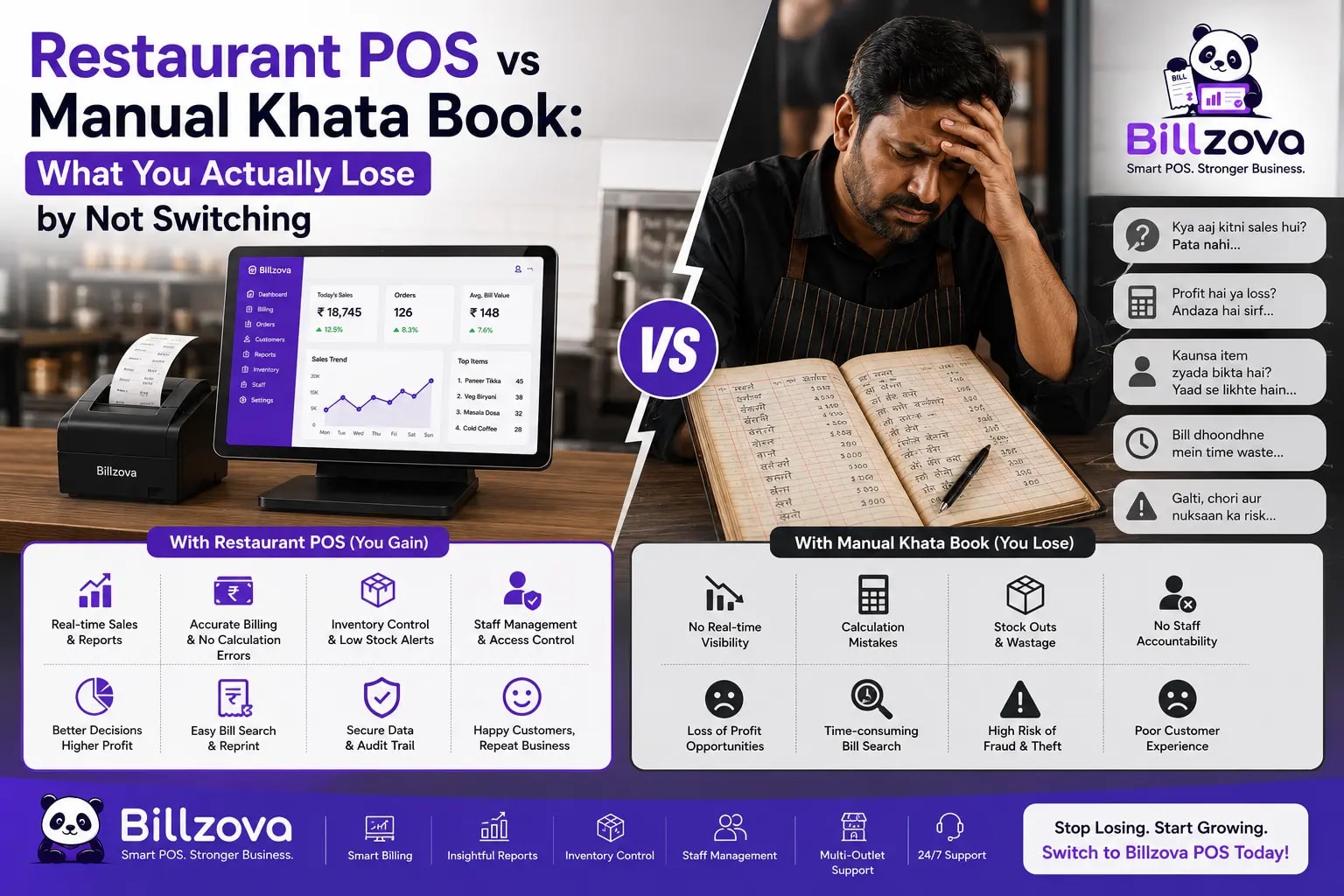
The khata book — a simple bound ledger, entries in pen, running totals kept by hand — is one of the most durable pieces of Indian small business infrastructure. It's cheap, it's familiar, it never crashes, and generations of shopkeepers and restaurant owners have run entire businesses on exactly this system. This isn't an article mocking that. It's an honest look at what a khata book genuinely does well, and — separately, just as honestly — what it structurally cannot do at all, regardless of how carefully it's kept.
Jack Welch
Former CEO, General Electric
That's not a dig at anyone still running a khata book today — plenty of profitable restaurants do. It's a genuine question worth sitting with: is the switch to digital billing something you'll make on your own terms, when you have time to do it properly, or something forced on you later by a GST notice, a lost reconciliation, or simply growing past the point where a hand-written ledger can keep up? This guide is about making that an informed choice rather than a reactive one.
What a Khata Book Actually Does Well
Credit where it's due, honestly: a khata book has real advantages that shouldn't be dismissed. It requires no internet connection, no device, no login, no learning curve beyond basic literacy. It has zero ongoing cost. It never has a software bug, a subscription lapse, or a compatibility issue. For a very small, informal operation — a single person, minimal transaction volume, no GST registration yet — it can genuinely be an adequate, low-friction way to keep basic records.
The honest case for a khata book isn't nostalgia. It's that for the narrowest possible use case — extremely low volume, no compliance complexity, no need for the operational visibility a growing business eventually needs — it does the one job it's built for, at zero cost, with zero setup.
What a Khata Book Can't Do At All
The moment a restaurant has any real GST obligation, the limitations stop being minor inconveniences and become structural gaps that no amount of careful handwriting can fix.
Warning
This isn't a hypothetical risk for a restaurant with any real GST registration — it's the actual, current legal requirement for issuing a compliant tax invoice. A khata book can record that a sale happened and roughly how much was collected. It cannot generate the specific, structured document GST law actually requires for that sale.
The Hidden Cost of "Free"
A khata book has no subscription fee, which makes it easy to think of as genuinely free. The real cost is time — and it's a cost that scales with the business rather than staying fixed. Reconciling a full month of hand-written entries at filing time, cross-checking totals, catching arithmetic errors, and translating everything into whatever format an accountant actually needs is real, recurring labor that a digital system does automatically as a byproduct of normal billing.
| Khata Book | Digital POS | |
|---|---|---|
| Upfront cost | Essentially free | A monthly subscription |
| GST-compliant invoices | Not possible | Automatic on every bill |
| Month-end reconciliation | Manual, time-consuming, error-prone | Reports generated automatically |
| Item-wise sales visibility | None, practically speaking | Real-time, by item and category |
| Staff accountability | Whoever's handwriting is in the book | Individual logins, full audit trail |
| Works without a person remembering to write it down | No — depends entirely on discipline | Yes — billing itself creates the record |
The "free" khata book's real cost shows up as accumulated hours every single month, for as long as the business operates — hours a digital system spends once, on setup, rather than repeatedly, forever.
What You Literally Cannot Know Running on a Khata Book
Beyond compliance, there's an entire category of business insight that a hand-written ledger structurally can't produce, no matter how disciplined the record-keeping is. Which specific dishes are actually driving revenue, item by item? What's your real food cost percentage per dish, not just a rough monthly guess? Which staff member handled which transactions, and is there a pattern worth understanding in voids or corrections? Which customers are genuine repeats, and how often do they actually come back?
None of these questions are answerable from a khata book, regardless of how carefully it's kept — the format itself only ever captures a running total, not the structured, itemized data that answering any of these questions actually requires. A digital system doesn't just record the same information faster; it captures fundamentally more information as a natural byproduct of billing, information a paper ledger was never designed to hold in the first place.
The GST Risk Specifically
This deserves its own section because it's the single highest-stakes gap, not just an inconvenience. GST regulations require specific, structured invoice data — and a restaurant issuing hand-written bills that don't meet that structure is exposed to real compliance risk regardless of whether the underlying sales figures are honest and accurate. The risk isn't about dishonesty; it's about a document format that was never built to satisfy a legal requirement that now exists.
This is a genuinely different category of problem than "our record-keeping could be a bit more organized." A restaurant that's GST-registered and issuing non-compliant invoices has a real, current legal exposure — not a someday risk, an active one, every single day it continues operating this way. The specific requirements — correct CGST/SGST structure, sequential numbering, GSTIN on every bill — are covered in full in our GST compliance guide, and the monthly filing that all of this feeds into is covered in our GSTR-1 filing guide — a filing process that becomes genuinely difficult, not just tedious, when the underlying invoices were never structured correctly to begin with.
What Happens With More Than One Person Handling Billing
A khata book has a quiet assumption baked into it: one person, or a small, consistent group, doing the writing, in a shared, legible hand, that everyone involved can read and trust. That assumption holds reasonably well for a very small operation. It breaks down as soon as a restaurant has multiple staff members taking payments across different shifts — different handwriting, different levels of diligence about writing every transaction down consistently, and no real way to know afterward who wrote which entry if a discrepancy shows up.
This connects to a broader point covered in our staff management guide — accountability requires knowing who did what, and a shared paper ledger structurally cannot provide that the way individual digital logins can. A khata book doesn't just lose GST compliance and reporting as a restaurant grows past one person handling everything; it loses the ability to know, after the fact, whose entry is whose at all.
A Month-End Close, Two Ways
Picture the same restaurant, closing out a month's books both ways.
Khata book: The owner or a family member spends an evening — sometimes more than one — going through every page of the month's entries, adding up daily totals by hand, cross-checking against whatever cash was actually on hand, and trying to reconstruct a GST-usable summary from entries that were never structured for that purpose in the first place. Arithmetic mistakes happen, get caught eventually (or don't), and the whole process gets handed to an accountant who then has to do their own reconciliation on top of it, since a running total in a ledger isn't itself a GST-ready filing input.
Digital billing: Every sale was already correctly categorized — by tax rate, by item, by payment method — the moment it happened, as a natural byproduct of billing rather than a separate end-of-month task. Closing the month is a report generated in seconds, already structured the way an accountant actually needs it. The evening previously spent on manual reconciliation is simply free.
1 evening/month
"But I've Always Done It This Way"
This resistance is completely understandable and worth addressing directly rather than dismissing. A system you've run successfully for years feels safe precisely because it's familiar — you know its quirks, you trust your own handwriting, and a new system is, by definition, unfamiliar and a little intimidating at first. That's a real, legitimate hesitation, not a character flaw.
The honest response isn't "just switch, it's easy" — it's acknowledging that any change involves a real, if temporary, adjustment period, while being clear that the underlying task (billing a customer) doesn't actually get more complicated on a digital system — in most cases, it gets faster once the initial adjustment is past, since correct tax calculation and record-keeping happen automatically instead of being a separate manual step every single time.
What Switching Actually Involves
Checklist
- Setting up your menu items with correct prices and GST rates — a one-time task, not a recurring one
- A short adjustment period for staff learning the new billing flow, typically measurable in days, not weeks
- Choosing a system that works offline, so power or internet issues don't become a new point of failure
- Keeping your existing records available for reference during the transition, rather than needing to migrate historical khata entries
- Starting with a real trial period before fully committing, so the switch is evaluated on your own actual experience, not a sales pitch
None of this requires a major IT project or a significant upfront investment — a modern restaurant POS, done right, is closer in setup effort to a new phone than to enterprise software, precisely because it's built for restaurant owners, not IT departments.
When a Khata Book Is Genuinely Still Fine
In the interest of the same honesty this guide opened with: a very small, genuinely informal operation — someone testing a food concept before formal registration, an extremely low-volume setup with no GST obligation yet — may not urgently need to switch. The case for digital billing gets stronger, and eventually becomes close to mandatory in practice, specifically once GST registration, any real transaction volume, or any actual need to understand your own business's real performance enters the picture. Recognizing which situation you're actually in matters more than a blanket "everyone must switch immediately" message.
What the First Two Weeks After Switching Actually Look Like
The honest version of this, not the marketing version: the first few days after moving off a khata book are usually a little slower than the old routine, not faster. Staff are typing instead of writing, someone is double-checking totals out of habit even though the system is doing the math correctly, and the owner is probably watching the register more closely than usual just to build confidence. That adjustment period is real and worth expecting rather than being surprised by.
What tends to change by roughly the second week is that the checking-out-of-habit stops, because the system hasn't produced a wrong total yet, and the actual billing itself — no mental tax calculation, no hunting for a pen, no flipping to a fresh page — starts feeling faster than the khata book ever was, not just more accurate. The restaurants that struggle with the transition are almost always the ones that tried to run both systems in parallel indefinitely rather than committing to the digital system as the actual record once the adjustment period passed.
A useful way to think about the switch: it's not that a khata book is a bad tool. It's that it was built for a version of running a restaurant that didn't include GST-compliant invoicing, multi-person billing accountability, or the expectation that an owner can check today's real numbers without waiting for month-end. A restaurant's needs changed; the tool didn't. A restaurant POS built for exactly this transition closes that gap without asking an owner to give up the parts of the old system — simplicity, reliability, low friction — that actually worked.
Frequently Asked Questions
Is it actually illegal to run a GST-registered restaurant on a khata book?
The legal requirement is that a GST-registered business issues compliant invoices with the correct structure — a khata book alone can't produce that structure, so the exposure comes from that gap, not from the ledger itself being inherently illegal to keep as a supplementary record.
How long does it actually take to switch from a khata book to a digital POS?
Basic setup — menu items, pricing, tax rates — is typically a matter of hours, not days, though staff comfort with the new flow builds over the following week or two of actual use.
Do I lose my historical records when I switch?
No — your existing khata book remains exactly as it was, as a physical historical record you can always refer back to. Switching to digital billing going forward doesn't require migrating or discarding past paper records.
What if my restaurant is very small — do I really need to switch?
If you're not yet GST-registered and running genuinely low volume, the urgency is lower — but it's worth revisiting the decision as soon as either of those changes, rather than waiting until a compliance issue forces the question.
Is a digital POS actually more reliable than a paper book, given power cuts and internet issues?
A properly built offline-first system continues billing normally through power or internet interruptions, syncing once connectivity returns — the reliability concern that makes paper feel safer is a solvable problem with the right kind of software, not an inherent digital weakness.
Can my accountant still work with my data if I switch to digital billing?
Generally, digital records are easier for an accountant to work with, not harder — structured, exportable data is a smaller reconciliation task than translating hand-written entries, which is exactly the reconciliation burden covered earlier in this guide.
What's the actual cost difference between a khata book and switching to a POS?
A khata book has no direct monetary cost; a POS typically involves a modest monthly subscription. The honest comparison isn't the sticker price alone — it's that cost weighed against the time saved, the compliance risk removed, and the operational visibility gained, which for any restaurant past a very small scale tends to outweigh the subscription cost fairly quickly.
Will my staff resist switching from a system they're already comfortable with?
Some initial resistance is normal and worth planning for honestly — but most staff, once through a short adjustment period, find billing on a proper system faster than manual entry, not slower, since tax calculation and totals happen automatically instead of being worked out by hand for every single bill.
Can I keep using a khata book alongside digital billing during the transition?
Many restaurants do exactly this during an initial adjustment period — running both briefly to build confidence before fully committing — though the real value only shows up once billing genuinely moves to the digital system as the actual source of record, not just a backup exercise.
Does a khata book cause problems even without any GST registration?
Less severely — without a GST obligation, the compliance risk specifically doesn't apply yet. The time-cost and lack-of-visibility problems covered in this guide still apply, just without the added legal exposure that comes once GST registration is in place.
Is switching worth it for a restaurant that's been profitable for years on a khata book?
Profitability despite the limitations covered in this guide isn't evidence the limitations don't exist — it's evidence the restaurant has succeeded in spite of them. The real question is how much more visibility, time, and compliance safety would be available with a proper system, not whether the current approach has technically "worked" so far.
What happens to my khata book habit if my restaurant's internet goes down after switching?
A properly built offline-first digital POS should continue billing normally without internet, the same reliability a khata book offers — the switch shouldn't trade paper's offline resilience for a system that stops working the moment connectivity drops.
Do I need to throw away my old khata books once I switch?
No — old khata books remain useful historical records and there's no requirement to discard them. The point of switching isn't to erase the past record, it's to make every future entry compliant, accurate, and instantly usable in a way the old format couldn't be, going forward from the day you switch.
Will switching from a khata book actually change how my restaurant is run day to day?
Less than owners often expect on the floor — orders still get taken, food still gets cooked and served the same way — and more than owners often expect behind the scenes, since decisions that used to wait until month-end, like which dishes to drop or which shift is underperforming, become things you can check the same evening instead.
The Bottom Line
A khata book isn't a bad system — it's a system built for a different, simpler requirement than what most operating restaurants actually need today. The honest case for switching isn't that paper is embarrassing or outdated; it's that GST compliance genuinely requires structured invoices a hand-written ledger can't produce, and that the time cost of manual reconciliation compounds every single month for as long as you keep doing it by hand.
The Jack Welch line this guide opened with cuts both ways: change on your own terms, when you have the time and clarity to do it properly, is a fundamentally different experience than change forced on you by a GST notice or a reconciliation that no longer adds up. Nothing about a khata book makes that choice for you — but nothing about it makes the choice go away either.
billzova is a restaurant POS built specifically to make that switch low-friction — GST-compliant billing from day one, works fully offline, ₹399/month with your first month free. If you're weighing whether it's time, that's worth a direct look at what your own restaurant would actually gain.
Billzova Team
Restaurant POS & Billing Experts
We build Billzova — GST billing, KOT, offline mode, inventory and reports for Indian restaurants. This team writes from what we see helping real restaurants bill faster every day.
Run your restaurant on billzova
GST billing, KOT, offline mode, inventory & reports in one app. ₹399/month — first month free.