How Much Does It Cost to Open a Restaurant in India in 2026?
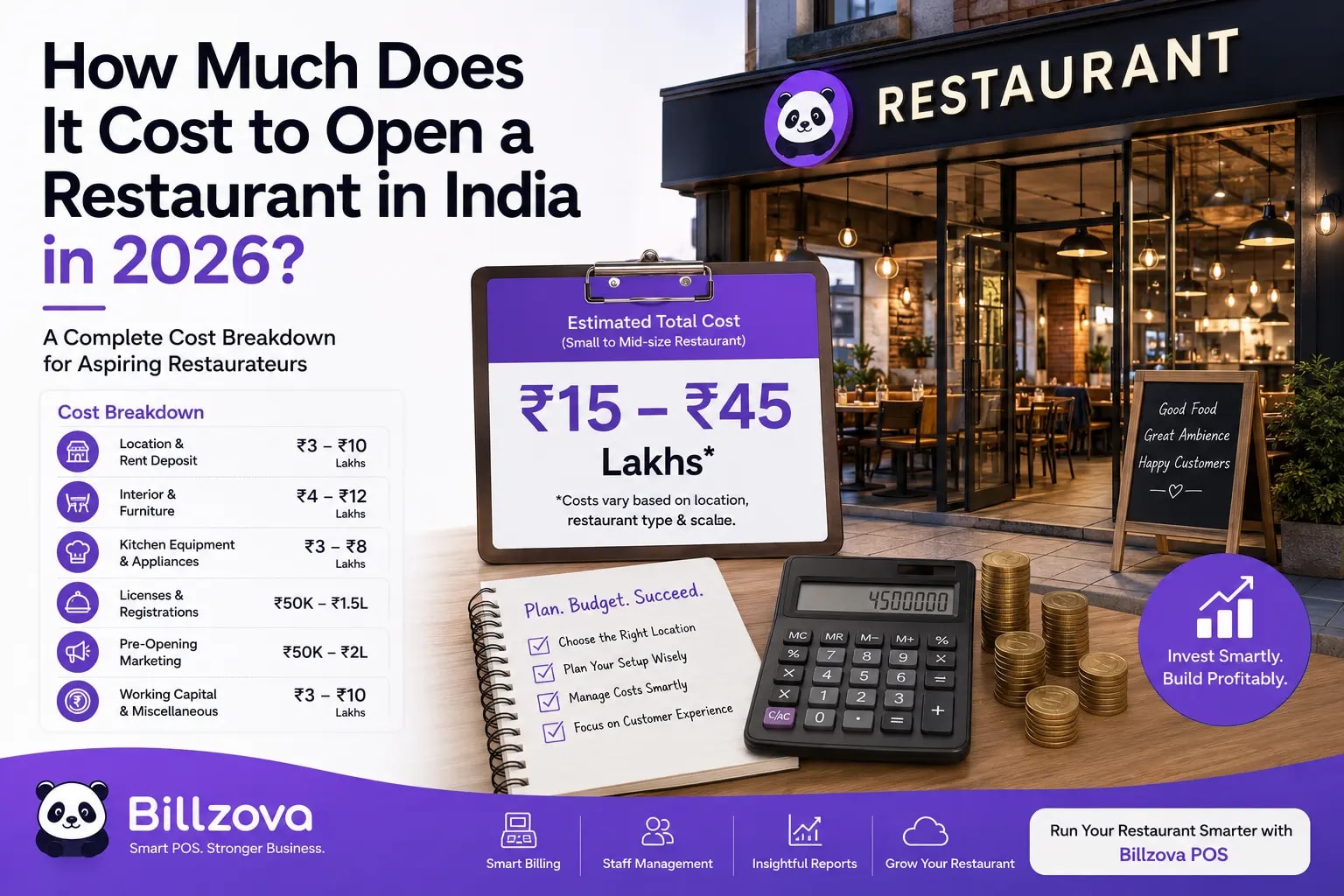
"How much does it cost to open a restaurant in India?" doesn't have one honest answer — a small cloud kitchen and a full-service dine-in restaurant in a metro city can differ in startup cost by a factor of twenty or more, and most of the generic answers floating around online quietly assume one specific format while presenting the number as if it applies to all of them. This guide breaks the real cost down by format and by line item, so the number you land on actually reflects what you're planning to build, not a generic average that doesn't match your situation.
The Short Answer: It Depends Entirely on Format
| Format | Typical Total Investment |
|---|---|
| Cloud kitchen / delivery-only | ₹2 lakh – ₹8 lakh |
| Small QSR / takeaway counter (Tier-2 city) | ₹5 lakh – ₹8 lakh |
| Small dine-in restaurant (Tier-2 city) | ₹8 lakh – ₹15 lakh |
| Medium restaurant (metro city) | ₹35 lakh – ₹50 lakh |
| Full-scale dine-in, prime metro location | ₹50 lakh – ₹1.5 crore+ |
These are real, commonly cited ranges — not a single official number, because none exists. City, exact locality, restaurant size, and how premium the interior finish is all move the number substantially within each band. The point of this table isn't precision to the rupee; it's giving you an honest order-of-magnitude answer before you go further into the specific line items below.
Notice, too, how wide some of these bands are even within a single format — "medium restaurant, metro city" spans a ₹15 lakh range on its own, because "metro city" covers everything from a modest neighborhood locality to a premium high-street address, and those two settings can have wildly different rent, footfall expectations, and required interior finish for what's nominally the same restaurant category. Treat every number in this guide as a realistic planning range to stress-test your own assumptions against, not a fixed price tag to budget to the rupee.
Rent and Security Deposit — Usually the Biggest Line Item
For any format with a physical premises, rent and the associated security deposit tend to be the single largest upfront cost, and the one most sensitive to location. In tier-1 cities like Delhi, Mumbai, or Bengaluru, monthly rent for a restaurant-suitable commercial space can run anywhere from roughly ₹1 lakh to ₹5 lakh or more depending on the locality and footfall. Landlords typically expect 3 to 6 months of rent as an upfront security deposit — which means the deposit alone, before a single chair is bought or a single dish is cooked, can easily represent ₹3-15 lakh of the total startup budget in a metro location.
A cloud kitchen sidesteps most of this cost entirely, since it doesn't need a customer-facing, high-footfall location — a smaller, cheaper commercial kitchen space in a less prime locality works just as well operationally, which is a large part of why the delivery-only model has such a dramatically lower entry cost. Our cloud kitchen vs. ghost kitchen guide covers what that model actually involves if a lower-capital entry point is part of your plan.
Kitchen Equipment and Interiors
Kitchen equipment — ranges, exhaust systems, refrigeration, prep counters, and the specific equipment your menu requires (a tandoor, a dosa griddle, a pizza oven) — typically runs ₹3-8 lakh for a small to mid-sized kitchen, and can climb well past that for specialized or higher-volume equipment. Interiors and furniture for a dine-in restaurant add a separate, often comparably sized cost: rough mid-range interior finishing commonly runs ₹1,500-2,500 per square foot in many urban markets, meaning even a modest dining area can represent several lakh rupees in fit-out cost before any equipment is counted.
A cloud kitchen or takeaway-only counter avoids the interior/furniture cost almost entirely, which is the second major reason the delivery-only model has such a different cost profile from a full dine-in restaurant — no dining room means no chairs, no décor budget, and no square-footage premium for customer-facing space.
Licenses and Registration — Small in Rupees, Not Small in Consequence
Info
Staff and Initial Inventory
Staffing costs before you've served a single customer are easy to underestimate, because they start accruing the moment you hire — typically at least a few weeks before opening, for training and setup. A full-service restaurant running with 10-12 staff can allocate roughly ₹1.2-2.5 lakh a month toward payroll once operating, and hiring generally needs to happen ahead of opening day, not on it. Initial inventory — the first stock of raw materials, packaging, and consumables — is a smaller one-time cost but still real money tied up before any revenue comes in to offset it.
Working Capital: The Line Item That Actually Sinks New Restaurants
3-6 months
This is, honestly, the most consequential line item in this entire guide, and the one most frequently left out of a new restaurant's budget entirely. It's not enough to fund the opening — rent, equipment, licenses, interiors. A restaurant also needs enough cash reserved to cover ongoing monthly costs (rent, salaries, raw materials, utilities) for several months while the customer base is still building and revenue hasn't caught up to expenses yet. For a small restaurant with monthly operating costs around ₹2-3 lakh, that can mean an additional ₹6-18 lakh in working capital reserved specifically to survive the gap between opening day and actual profitability — money that isn't spent on anything visible, but that determines whether the restaurant survives its first six months.
Running out of working capital before reaching profitability, not bad food or bad service, is one of the most common reasons new restaurants fail in their first year. It's an unglamorous line item compared to interiors or menu development, and it's exactly the one most first-time owners underbudget.
Marketing and Pre-Launch Costs
A restaurant with zero customer awareness on opening day doesn't fill up by accident — building initial footfall or delivery order volume takes a real, budgeted marketing push, not an assumption that a good menu markets itself. For a dine-in restaurant, this typically means a launch-period budget covering local promotion, signage, an opening event or soft-launch offer, and getting listed properly on Google and relevant local discovery platforms. For a delivery-first cloud kitchen, marketing looks different but is arguably even more essential, since there's no physical storefront generating any organic walk-in awareness at all — every single early customer has to be actively acquired through an aggregator app's search and promotion tools, paid visibility on that platform, or direct social media and WhatsApp marketing. Restaurants that treat marketing as something to figure out after opening, rather than a funded line item from day one, routinely underperform their own break-even projections simply because the customer base they were counting on took longer to build than planned.
Financing the Investment: Where the Money Actually Comes From
Very few first-time restaurant owners fund the entire setup cost from personal savings alone — a mix of personal capital, a business loan, and sometimes a contribution from a co-founder or family investor is far more typical. Lenders evaluating a restaurant loan application generally want to see a realistic, itemized budget that explicitly includes working capital, not just the visible setup costs like equipment and interiors — a loan application that only accounts for "opening costs" and ignores the months of operating losses before break-even is a weaker application, not a stronger one, because it signals the owner hasn't planned for the period that actually determines survival.
It's also worth separating two very different kinds of financing need: the one-time capital to open (equipment, deposit, licenses, interiors) versus the revolving working capital to operate through the early loss-making months. Some owners fund the first with a term loan and keep the second as a separate cash reserve or line of credit specifically so a slow month doesn't force cutting corners on food quality, staffing, or compliance just to preserve cash — corners that, once cut, are hard to win customers back from.
A useful discipline here, regardless of how the money is sourced: keep the working capital reserve genuinely untouched during the setup phase, even when a fit-out runs slightly over budget and it's tempting to dip into it. Setup overruns and working-capital shortfalls are two separate risks, and letting one quietly absorb the other just relocates the failure point from "opening" to "month four," which is a worse place for it to happen.
When Each Cost Actually Hits Your Bank Account
Pre-Signing (2-3 months before opening)
Location research, lease negotiation, and initial license applications begin — minimal capital outlay yet, mostly time.Lease Signing
Security deposit (3-6 months' rent) becomes due immediately, typically the single largest cash outflow of the entire process.Fit-Out Phase (1-2 months)
Kitchen equipment purchase and interior construction/furnishing happen in parallel, alongside FSSAI and GST application processing.Pre-Opening (2-4 weeks before launch)
Staff hiring and training, initial inventory purchase, POS and systems setup, marketing launch preparation.Opening Day Onward
Ongoing monthly operating costs begin, offset only partially by revenue for the first several months — this is where the working capital reserve gets used.
Seeing the costs laid out on a timeline rather than as one lump total makes the working capital point land more clearly: by the time a restaurant actually opens its doors, a large share of the total investment is already spent, and the working capital reserve exists specifically to cover the gap between "doors open" and "revenue reliably exceeds monthly costs" — a gap that routinely runs three to six months, not the few weeks first-time owners often assume.
Owning vs. Franchising: A Different Cost Shape Entirely
Everything in this guide assumes building an independent restaurant from scratch. Buying into an established franchise is a genuinely different financial model — typically a franchise fee paid upfront, plus build-out costs to the franchisor's specified standards (often less flexible, and sometimes more expensive, than an independent owner could achieve with the same budget), plus ongoing royalty payments as a percentage of revenue for the life of the agreement. The tradeoff is real: a franchise generally arrives with brand recognition, a proven menu, and operational playbooks that reduce some of the early uncertainty this guide covers, in exchange for less control and a permanently higher cost structure than an equivalent independent restaurant. Neither model is universally better — it depends on how much an owner values a proven system against full control and a potentially lower total cost of ownership over time.
A Worked Example: Small Tier-2 QSR Budget
To make this concrete, here's a realistic breakdown for a small QSR/takeaway counter opening in a tier-2 city, aiming for the lower end of the cost spectrum:
| Item | Estimated Cost |
|---|---|
| Rent deposit (3 months, small commercial space) | ₹90,000 – ₹1.5 lakh |
| Kitchen equipment (basic QSR setup) | ₹2 lakh – ₹3.5 lakh |
| Interior/counter fit-out (minimal, takeaway-format) | ₹1 lakh – ₹2 lakh |
| FSSAI + GST + local licenses | ₹30,000 – ₹75,000 |
| Initial inventory and packaging | ₹50,000 – ₹1 lakh |
| POS/billing system (first year, indicative) | ₹4,800 – ₹5,000 |
| Working capital reserve (3 months minimum) | ₹3 lakh – ₹6 lakh |
Notice where the POS/billing line sits in that table — a small, largely fixed cost next to rent, equipment, and working capital, which are the numbers that actually move the total up or down by lakhs. This is worth pointing out plainly: software cost is rarely the deciding factor in whether a restaurant budget works, but skimping on it by staying on manual billing carries its own real cost later, in GST compliance risk and time lost to reconciliation — a trade-off our honest khata book comparison covers if manual billing is part of your current plan.
Where First-Time Owners Most Commonly Underbudget
Checklist
- Skipping or shrinking the working capital reserve, assuming break-even happens faster than it typically does
- Underestimating the security deposit as "just rent," forgetting it's 3-6 months upfront, not one
- Budgeting licenses as a one-time cost while forgetting FSSAI tier upgrades and ongoing GST filing obligations as the business grows
- Treating marketing as an afterthought instead of a real line item needed to build a customer base from zero
- Underestimating how long pre-opening staffing and training actually take before any revenue starts coming in
Ongoing Monthly Costs, Once You're Open
The one-time setup cost is only half the picture — what it actually costs to keep the doors open every month is a separate, ongoing number that needs its own budget line. A small takeaway outlet can run on roughly ₹50,000 a month at the very low end, while a small-to-mid dine-in restaurant more typically sits in the ₹1-3 lakh monthly range covering rent, salaries, raw materials, and utilities. A large fine-dining establishment or a multi-outlet chain can push past ₹15-20 lakh a month in operating costs. This is the number your working capital reserve is actually protecting you against during the months before revenue reliably covers it.
Frequently Asked Questions
What's the cheapest way to start a food business in India?
A cloud kitchen or delivery-only model, typically ₹2-8 lakh total, since it avoids the two largest cost drivers of a dine-in restaurant — a high-footfall location and a customer-facing interior fit-out — entirely.
Is ₹10 lakh enough to open a restaurant?
It can be, for a small QSR or takeaway-format restaurant in a tier-2 city, but it's tight for a genuine dine-in restaurant in a metro location once rent deposit, interiors, and working capital are all accounted for realistically rather than optimistically.
How much of the total budget should go toward working capital?
A commonly used rule of thumb is 3 to 6 months of full operating expenses set aside separately from setup costs — for a restaurant spending ₹2-3 lakh a month to run, that's roughly ₹6-18 lakh reserved purely to survive the gap before profitability.
Does the cost estimate include the POS/billing system?
It should, though it's usually a small line item relative to rent, equipment, and working capital — a restaurant POS like billzova runs ₹399/month, which is a rounding error against a ₹10-50 lakh total setup budget, even though the compliance and time-saving value it provides is not.
Can I open a restaurant with a bank loan instead of my own capital?
Many first-time owners do combine personal savings with a business loan, though lenders typically want to see a realistic budget that includes working capital, not just setup costs — which is exactly the gap this guide is trying to help you avoid.
How much does opening in a metro city cost compared to a tier-2 city?
Substantially more — primarily driven by rent and interior fit-out costs, which scale directly with locality and footfall. A comparable restaurant format can easily cost two to four times more to open in a prime metro location than in a tier-2 city.
Should I start small and expand later, or open at the scale I actually want from day one?
Starting smaller and proving the concept works before committing to a larger investment is generally the lower-risk path, particularly for a first-time owner — a cloud kitchen or small QSR format that validates demand and refines the menu before a bigger dine-in investment reduces the odds of sinking a large budget into a concept that hasn't been market-tested yet.
Is a franchise a cheaper way to open a restaurant than starting independently?
Not usually cheaper upfront — a franchise typically adds a franchise fee and ongoing royalty payments on top of build-out costs, in exchange for brand recognition and a proven operating system. Whether that trade is worth it depends on how much value you place on reduced uncertainty versus a lower total cost and full independent control.
What's the single most common financial mistake new restaurant owners make?
Underbudgeting working capital specifically — spending the full available budget on visible setup costs like interiors and equipment, and having little to nothing left to cover operating losses during the months before the business reaches break-even.
Do these cost estimates include GST or other taxes on the setup expenses themselves?
Generally not fully baked into the ranges cited here — equipment purchases, interior contracting, and various services involved in setup typically carry their own applicable GST, which is a real additional cost on top of the base figures and worth confirming with vendors and contractors directly rather than assuming the quoted price is the final one.
The Bottom Line
There's no single honest number for "the cost to open a restaurant in India" — the real answer depends on format first, and location and scale second. What stays consistent across every format is that working capital and licensing are the two line items first-time owners most reliably underbudget, not the equipment or interiors that get the most attention during planning.
If there's one takeaway worth carrying out of this entire guide, it's that the number you should be budgeting against isn't "what will it cost to open" but "what will it cost to open and survive the first six months" — those are genuinely different figures, and confusing them is the single most common reason realistic-looking budgets still run out of cash before the business finds its footing. A budget built on the first question alone almost always looks more achievable than it actually is.
Once you've settled on a format and budget, getting your FSSAI and GST registrations right and billing compliantly from day one — rather than retrofitting compliance later — is one of the cheapest, most controllable parts of this entire budget. billzova is a restaurant POS built for exactly that, at ₹399/month with your first month free.
Billzova Team
Restaurant POS & Billing Experts
We build Billzova — GST billing, KOT, offline mode, inventory and reports for Indian restaurants. This team writes from what we see helping real restaurants bill faster every day.
Run your restaurant on billzova
GST billing, KOT, offline mode, inventory & reports in one app. ₹399/month — first month free.