FSSAI License and GST Registration for Restaurants: What You Actually Need
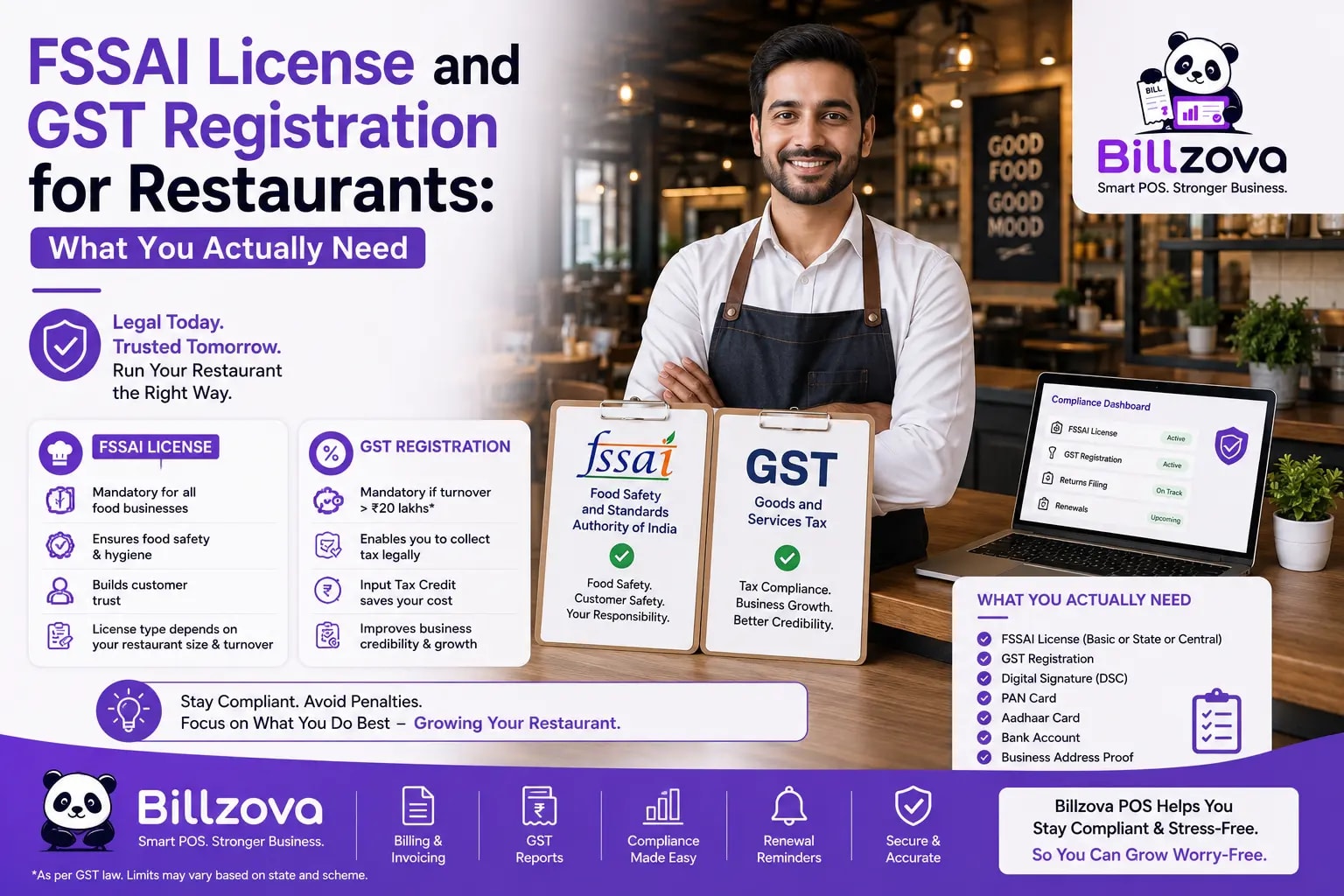
Two government registrations sit between "I want to open a restaurant" and "I can legally serve food and issue a bill for it" — an FSSAI license and GST registration. They get confused constantly, partly because both involve the word "registration" and both feel like paperwork standing between you and actually opening, but they regulate completely different things, come from completely different authorities, and getting one right does nothing to satisfy the other.
Benjamin Franklin
This guide is deliberately narrow: what FSSAI actually requires, what GST actually requires, how they're different, and — because the rules changed significantly in 2026 — what's actually true right now rather than what older articles still say. If you're already GST-registered and looking for how to bill compliantly day to day, our GST billing guide picks up from exactly where this one ends.
FSSAI License: What It Actually Regulates
The Food Safety and Standards Authority of India (FSSAI) is the food safety regulator — its license has nothing to do with tax. It exists to certify that a business handling food meets baseline safety, hygiene, and quality standards. Any commercial food business in India, restaurant or otherwise, needs an FSSAI license or registration before it can legally operate, regardless of size. The only question is which tier.
The Three FSSAI Tiers — and a Major 2026 Change
FSSAI licensing has always worked on three tiers based on annual turnover and business type: Basic Registration for the smallest operators, a State License for mid-sized businesses, and a Central License for the largest or for specific high-risk activity types regardless of size. What changed is where the lines between those tiers sit.
Warning
| Tier | Annual Turnover | Typical For |
|---|---|---|
| Basic Registration | Up to ₹1.5 crore | Small and mid-sized independent restaurants, cafés, cloud kitchens, food stalls |
| State License | ₹1.5 crore – ₹50 crore | Larger single-state restaurants, small chains operating within one state |
| Central License | Above ₹50 crore | Large multi-state chains, importers, and specific activity types regardless of turnover |
That last point about activity type matters independent of turnover: a restaurant that imports specialty ingredients, operates as part of a 100%-export-oriented business, or supplies food to central government establishments needs a Central License regardless of how small its turnover actually is. Turnover alone doesn't always decide the tier.
Which Tier Your Restaurant Actually Falls Into
For most independent restaurants and small chains opening today, the honest, practical answer is Basic Registration — the ₹1.5 crore threshold is high enough that it now covers the overwhelming majority of single-location and small multi-location restaurants that would previously have needed a State License. A restaurant only needs to think seriously about a State License once turnover is genuinely approaching or past that ₹1.5 crore mark, or a Central License once it's operating at real multi-state scale.
One detail worth flagging for anyone running (or planning to run) more than one location: FSSAI licensing is generally tied to each operating premise, not the business as a single entity — a restaurant with branches in different states typically needs licensing consideration per location, not one license covering everywhere. If multi-location operations are part of your plan, our multi-branch management guide covers the broader operational side of running more than one outlet, though the FSSAI licensing specifics should always be confirmed directly on the FoSCoS portal for your actual footprint.
Documents You'll Actually Need
The exact document list varies slightly by tier and state, but for a typical restaurant applying for Basic Registration or a State License, the FoSCoS portal (FSSAI's official application system) generally asks for:
To Do
- Photo ID and address proof of the business owner/proprietor
- Proof of business premises (rent agreement or ownership document, plus a landlord NOC if rented)
- A geo-tagged photograph of the premises — a requirement added under the 2026 rules
- A list of food items/categories the restaurant will handle
- Partnership deed or incorporation certificate, if applicable
- A Food Safety Management Plan (FSMP), required for State and Central License applications specifically, not Basic Registration
- Water testing report, for State/Central applications where water is used directly in food preparation
Basic Registration is generally issued without a physical inspection and tends to move faster — often within one to two weeks. State and Central License applications typically involve a premises inspection and take longer, commonly four to eight weeks depending on the state and the specific licensing authority's backlog.
The License No Longer Expires — But Read That Carefully
This is the second major change worth knowing about: under the 2026 amendment, FSSAI licenses issued from 1 April 2026 onward have perpetual validity — the old system of a fixed 1-to-5-year license that had to be actively renewed before expiry has been discontinued. Practically, this removes one of the most common real-world compliance failures: restaurants that quietly kept operating on an expired license because a renewal deadline was missed.
The honest caveat: "perpetual validity" describes the license itself, not necessarily every ongoing obligation attached to it. Multiple aspects of the annual fee and compliance-reporting cycle under the new rules are still being clarified in practice as licensing authorities implement the change, and different sources describe the fee mechanics slightly differently. Treat the core fact — your license no longer has a hard expiry date to track — as solid, and confirm the current fee and reporting cycle directly on FoSCoS at the time you actually apply, since that's the detail most likely to keep getting refined as the rollout matures.
The Food Safety Supervisor Requirement
One FSSAI obligation that gets missed even by restaurants that got their license itself right: every food business unit above a certain scale is required to designate a trained Food Safety Supervisor (FSS) on-premise, someone who has completed FSSAI-recognized food safety training and is responsible for day-to-day hygiene compliance at that specific location. This isn't a one-time paperwork item alongside the license application — it's an ongoing operational requirement, and the person holding that role can change as staff turn over, which means it needs periodic attention rather than a single box ticked at opening.
For a restaurant with multiple locations, this compounds: each location genuinely needs its own designated, trained supervisor, not one person notionally covering every branch. It's a small detail next to the headline license question, but it's exactly the kind of requirement that shows up during an inspection and catches an otherwise fully-licensed restaurant off guard.
Local and State Permits — the Requirements Beyond FSSAI and GST
FSSAI and GST are the two most consequential, most search-for registrations, but they're rarely the only paperwork a new restaurant actually needs. Depending on the state and municipality, a restaurant may also need a trade license or shop establishment registration from the local municipal body, a fire safety NOC (especially relevant for any premises with a commercial kitchen), health trade license requirements that vary significantly by city, and — if alcohol is served — a separate excise license that operates entirely outside both FSSAI and GST's scope. None of these substitute for FSSAI or GST; they're additional, and which ones actually apply depends heavily on your specific city and state, which is why a local consultant or your municipal corporation's website is worth checking directly rather than assuming a fixed national list applies everywhere identically.
GST Registration: A Completely Separate Requirement
Where FSSAI is about food safety, GST is purely about tax — a different registration, a different authority, and a different threshold logic entirely. A restaurant must register for GST once its aggregate annual turnover crosses ₹20 lakh (₹10 lakh in specified special-category states). Below that threshold, GST registration generally isn't mandatory — but plenty of restaurants register voluntarily anyway, often because business customers or aggregator platforms expect a GSTIN before they'll work with a vendor at all.
Once registered, a restaurant has a real choice to make: Regular GST or the Composition Scheme. This is one of the most consequential compliance decisions a new restaurant owner makes, and it's worth understanding clearly rather than defaulting into whichever option a local consultant mentions first.
| Regular GST | Composition Scheme | |
|---|---|---|
| Turnover eligibility | No upper limit | Up to ₹1.5 crore (₹75 lakh in special category states) |
| Tax rate | Standard restaurant GST rates apply | Flat 5% on turnover |
| Input Tax Credit (ITC) | Can be claimed | Cannot be claimed at all |
| Interstate outward supply | Permitted | Not permitted |
| Selling through Swiggy/Zomato etc. | Permitted | Not permitted under composition rules |
| Filing frequency | Monthly/quarterly returns (GSTR-1, GSTR-3B) | Simpler quarterly filing |
The composition scheme's restriction on aggregator sales is the detail that catches new restaurant owners off guard most often — a restaurant planning any real Swiggy or Zomato volume needs Regular GST, not composition, regardless of how attractive the flat 5% rate looks on paper. Once you're registered under whichever scheme fits, actually issuing compliant invoices on every bill — correct CGST/SGST split, sequential numbering, GSTIN printed correctly — is covered in full in our GST billing guide, and the monthly filing that follows from those invoices is covered in our GSTR-1 filing guide.
Switching between Regular GST and Composition isn't locked in forever, but it isn't something to flip casually either — moving out of composition mid-year, for instance because aggregator sales become part of the plan, involves its own filing process and generally can't be backdated to cover invoices already issued under the old scheme. The more reliable approach is deciding honestly, before registering, what the restaurant's actual sales channels will look like over the next year or two, rather than optimizing for the lowest headline tax rate today and re-deciding later under pressure.
It's also worth being clear about what GST registration does and doesn't require of a restaurant beyond the initial application. Once registered, a restaurant takes on recurring filing obligations — monthly or quarterly returns depending on the scheme, correct tax collection on every single bill, and accurate record-keeping that a tax officer can actually verify against real sales. None of that is optional once the GSTIN is issued; registering is the start of an ongoing compliance relationship with the tax authority, not a one-time certificate to file away.
FSSAI vs. GST: Why They're Easy to Confuse
The confusion is understandable — both feel like "the government registration I need before I can open" and both involve forms, fees, and a certificate to display. But they answer completely different questions, and having one says nothing about the other.
2
What Actually Happens If You Skip Either One
Operating a food business without a valid FSSAI license or registration is a genuine legal exposure, not a formality — FSSAI has the authority to issue penalties and, in serious or repeated cases, order closure of the premises. On the GST side, a restaurant that's crossed the registration threshold but hasn't registered is exposed to penalties calculated on the tax that should have been collected and remitted, plus interest, and every invoice issued in the meantime is technically non-compliant regardless of whether the underlying sales figures were honestly recorded. Neither risk is about intent — it's about the gap between what the business is actually required to have and what it currently holds.
Getting Both Right Before You Open
Checklist
- Determine your expected annual turnover honestly, before applying — it decides your FSSAI tier
- Apply for FSSAI Basic Registration or State License on the FoSCoS portal, with the correct document set for your tier
- Decide Regular GST vs. Composition Scheme based on your actual plans for aggregator sales and interstate supply, not just the lowest tax rate
- Register for GST once turnover crosses ₹20 lakh (₹10 lakh in special category states), or earlier if voluntary registration makes business sense
- Display both certificates at your premises as required
- Set up GST-compliant billing from your very first invoice, not retroactively once volume grows
That last point is where a lot of restaurants create avoidable work for themselves: getting both registrations right on paper and then continuing to bill on a hand-written register or a generic invoicing app that doesn't actually produce a GST-compliant tax invoice. If a manual system is still part of your plan, it's worth reading our honest comparison of what a khata book can and can't do once you're GST-registered — the gap between "recording a sale" and "issuing a compliant invoice for it" is exactly where restaurants that got their registrations right on day one still end up exposed later.
Frequently Asked Questions
Do I need FSSAI and GST registration before I open, or can I apply after I start operating?
Both are meant to be in place before you begin commercial food operations — operating without them, even briefly, is the actual legal exposure described above, not a technicality that gets resolved by applying later.
Can I run my restaurant on FSSAI Basic Registration and not worry about GST at all?
Only until your turnover crosses the GST registration threshold — the two obligations are independent and unrelated to each other's thresholds, so staying under the FSSAI Basic Registration ceiling says nothing about whether you've also crossed the separate GST threshold.
Is the FSSAI license per restaurant location or per business owner?
Generally per operating premises — a business with multiple locations typically needs licensing consideration for each one, not a single license covering the entire operation, though the exact requirement should be confirmed on FoSCoS for your specific footprint.
What happens if my restaurant's turnover grows past my current FSSAI tier?
You're expected to upgrade to the appropriate tier once your actual turnover crosses into the next bracket — continuing to operate under a lower tier than your real turnover justifies is the same category of exposure as not having a license at all.
Should I choose the GST Composition Scheme or Regular GST for a new restaurant?
It depends heavily on your actual business model — Composition offers a simpler flat 5% rate but blocks input tax credit, interstate supply, and aggregator platform sales entirely, so any restaurant planning real Swiggy/Zomato volume or multi-state supply needs Regular GST regardless of the lower headline rate on composition.
Does FSSAI registration cover food delivery and cloud kitchens the same way as dine-in restaurants?
Yes — FSSAI licensing requirements apply to any commercial food business regardless of format, so a cloud kitchen or delivery-only operation needs the same tier of FSSAI license a dine-in restaurant of equivalent turnover would need.
If my FSSAI license no longer expires, do I still need to do anything annually?
The headline change is that there's no fixed multi-year expiry to renew anymore — but ongoing annual fee and compliance-reporting obligations may still apply under the new rules, and the exact mechanics are worth confirming directly on FoSCoS at the time you apply rather than assuming "perpetual" means "nothing further required, ever."
Can I get GST registration before my FSSAI license is approved?
Yes — the two processes are independent and don't have to happen in a fixed sequence, though most restaurant owners find it simpler to have both in hand before actually opening, rather than juggling partial compliance while already serving customers.
Do I need a separate Food Safety Supervisor for each branch, or does one cover my whole restaurant chain?
Each operating location generally needs its own designated, trained Food Safety Supervisor — it's tied to the specific premises and its day-to-day operations, not to the business as a single legal entity, so a chain with multiple branches needs this covered branch by branch.
What other licenses might my restaurant need besides FSSAI and GST?
Depending on your city and state, commonly a municipal trade license or shop establishment registration, a fire safety NOC, and — if you serve alcohol — a separate excise license. These vary significantly by location, so confirming the exact list with your municipal corporation is more reliable than assuming a fixed national checklist.
If I'm just starting a small cloud kitchen with low turnover, do I really need to go through all of this?
Yes, at minimum FSSAI Basic Registration — turnover being low doesn't exempt a commercial food business from FSSAI entirely, it just determines which tier applies; GST only becomes mandatory once you cross the ₹20 lakh threshold, but plenty of small operators register earlier anyway for the reasons covered above.
The Bottom Line
FSSAI and GST are separate registrations answering separate questions — food safety and tax — and both are genuinely required for a legally operating restaurant, not optional formalities that matter only if you get audited. The 2026 changes make FSSAI meaningfully simpler for small and mid-sized restaurants specifically: a much higher Basic Registration threshold and no more hard expiry dates to track. GST's rules haven't changed, but the choice between Regular GST and Composition remains one of the most consequential early decisions a new restaurant owner makes.
Neither registration is something to treat as a one-time hurdle cleared at opening and then forgotten. FSSAI's supervisor requirement, GST's recurring filing obligations, and the possibility of outgrowing your current FSSAI tier as the business succeeds are all ongoing responsibilities, not closed items. Building that expectation in from day one — rather than discovering it later, under pressure, during an inspection or a filing deadline — is genuinely the difference between compliance being a background operational habit and compliance being a recurring source of stress.
Once both registrations are in place, the next practical question is how you'll actually bill compliantly, every single day, from day one. billzova is a restaurant POS built for exactly that — GST-compliant invoices automatically, correct tax structure on every bill, ₹399/month with your first month free.
Billzova Team
Restaurant POS & Billing Experts
We build Billzova — GST billing, KOT, offline mode, inventory and reports for Indian restaurants. This team writes from what we see helping real restaurants bill faster every day.
Run your restaurant on billzova
GST billing, KOT, offline mode, inventory & reports in one app. ₹399/month — first month free.