Cafe Management Guide: Fast & Profitable Cafes India
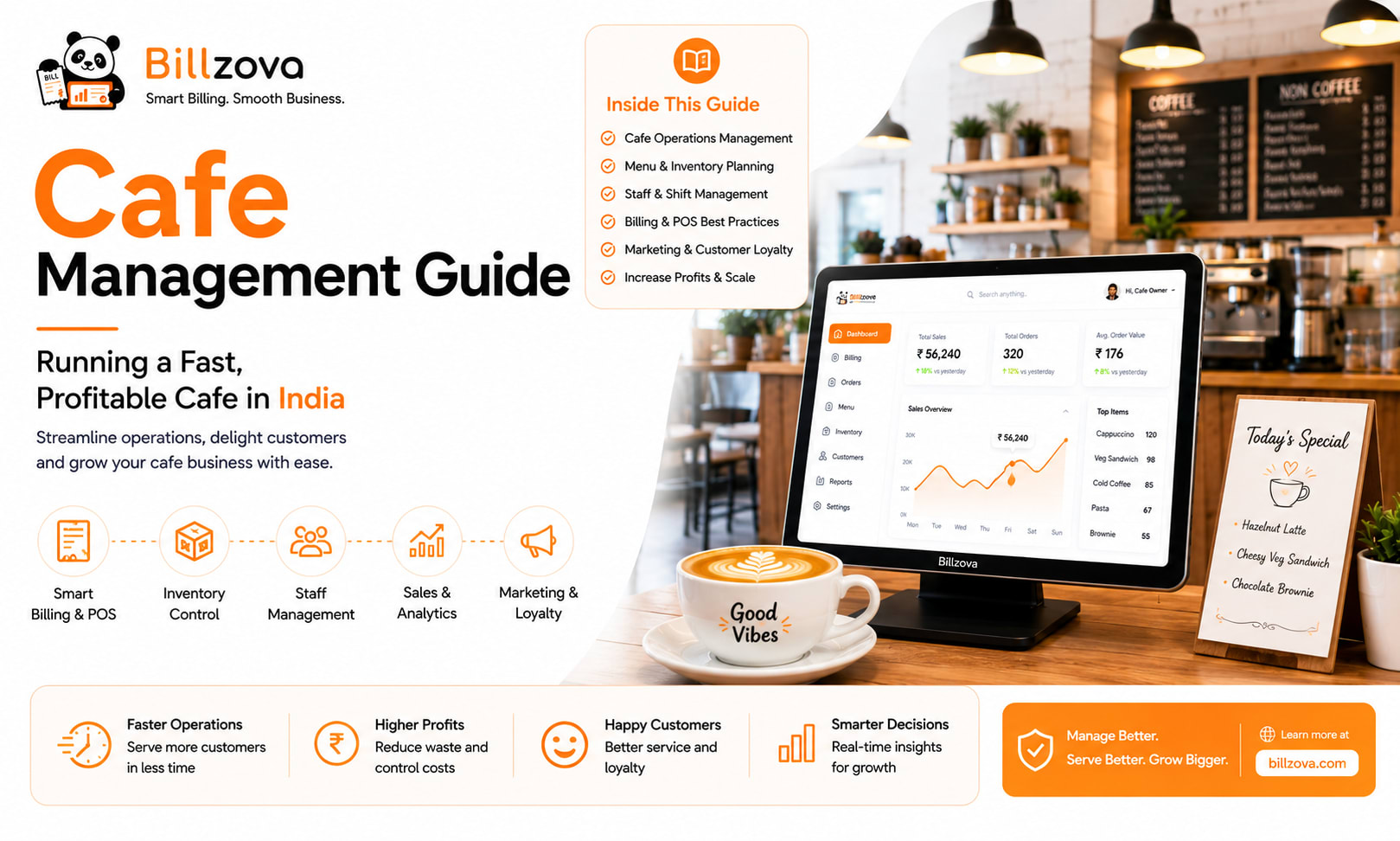
Cafe Management Guide: Running a Fast, Profitable Cafe in India
Cafes run on a different rhythm than full-service restaurants. There's no extended table service, no multi-course pacing — the entire operation compresses into short, high-volume windows where speed at the counter directly determines how much revenue passes through in a given hour. A cafe that's marginally slower per order than it needs to be doesn't just feel less efficient; it loses real, measurable revenue during exactly the hours that matter most.
This guide covers the specific operational priorities that matter most for cafes — queue speed, beverage-led margin management, loyalty and repeat-customer strategy, and staffing for sharply peaked demand — distinct from the broader restaurant management advice that doesn't always translate well to a counter-service, quick-turnover format.
Table of Contents
- Why Cafe Management Differs From Full-Service Restaurants
- Queue Speed: The Single Biggest Lever
- Beverage-Led Margin and Why It Matters
- Staffing for Sharply Peaked Demand
- Building Repeat-Customer Loyalty at a Cafe
- Managing Perishable Inventory at a Cafe
- Payment Speed and Method Mix
- Common Mistakes Cafe Owners Make
- Best Practices for Cafe Operations
- Where Cafe Management Is Headed
- Frequently Asked Questions
- Conclusion
Why Cafe Management Differs From Full-Service Restaurants
A full-service restaurant's revenue per table accumulates over an extended visit — appetisers, mains, dessert, often over 45 minutes to an hour or more. A cafe's revenue per customer is usually generated in a single, fast transaction, frequently completed within minutes. This compresses the entire profitability equation into throughput: how many customers can be served well per hour, rather than how much each table spends over a longer visit.
This single structural difference is why cafe management priorities — speed, queue management, beverage margin — differ meaningfully from general restaurant management advice, even though both fall under the broader "food service" umbrella.
Queue Speed: The Single Biggest Lever
During a morning or lunch rush, queue speed directly caps how much revenue a cafe can generate in that window — there's a hard ceiling on customers served per hour if billing and order preparation aren't fast enough, and that ceiling doesn't move regardless of how much demand exists beyond it.
- Quick-key menus — pre-configured buttons for your most common orders — remove the need to search through a full menu for every transaction.
- Fast payment processing across cash, UPI, and card, ideally without separate steps for each method.
- Clear, consistent order communication to the kitchen or counter, using a modern KOT printing software or a kitchen display system so preparation starts the instant an order is taken, not after a delay.
Every second saved per transaction compounds across the length of a rush — a small reduction in average transaction time can meaningfully increase how many customers a cafe serves before the rush ends.
Beverage-Led Margin and Why It Matters
Beverages — coffee, tea, and similar drinks — often carry significantly better margin than food items at a typical cafe, since ingredient cost per cup is usually low relative to the selling price. This means a cafe's overall profitability is often disproportionately driven by beverage sales, even when food items make up a meaningful share of the menu and revenue.
Understanding this changes how you think about promotions, upselling, and even menu layout — encouraging an additional beverage purchase often has a stronger margin impact than the same effort spent upselling a food item, simply because of the underlying cost structure difference.
Staffing for Sharply Peaked Demand
Cafes typically see demand concentrated into a few sharp peaks — morning, and often a midday lunch window — rather than spread evenly across the day. Staffing needs to match this pattern specifically, rather than a flat schedule that's either understaffed during peaks or overstaffed during quiet periods.
Shift-wise sales data is particularly useful here, since it shows exactly which hours generate the most revenue and therefore need the most staffing support, rather than relying on a generic assumption about when "the rush" happens.
Building Repeat-Customer Loyalty at a Cafe
Cafes are unusually well-suited to loyalty programs because customer visit frequency tends to be high — a regular customer might visit several times a week, far more often than the typical dine-in restaurant customer. This makes even a modest loyalty incentive (a discount after a certain number of visits, for example) potentially impactful, since the repeat-visit pattern is already there to build on.
The practical requirement is recognising a returning customer without adding friction to the fast transaction speed a cafe depends on — which is why automatic, phone-number-based tracking in a restaurant customer CRM tends to work better in this context than a separate loyalty card or app that requires extra steps at the counter.
Managing Perishable Inventory at a Cafe
Cafe inventory — milk, fresh pastries, certain syrups and toppings — often has a shorter shelf life than a typical restaurant's broader ingredient list, making over-ordering a more immediate and costly mistake. Real-time tracking via inventory management software helps avoid both stock-outs during a rush and spoilage from over-purchasing perishables.
Payment Speed and Method Mix
Cafes typically see a high proportion of digital payments, particularly UPI, given the customer demographic and transaction speed expectations. Billing software that handles cash, UPI, and card within the same fast flow — rather than requiring separate steps or screens per method — directly supports the speed priority that defines cafe operations.
Common Mistakes Cafe Owners Make
- Treating cafe management like full-service restaurant management, missing the speed and throughput priority that actually drives cafe profitability.
- Underestimating beverage margin's importance relative to food items when making promotional decisions.
- Flat staffing schedules that don't reflect actual peak-hour demand data.
- Loyalty programs that add friction to the fast counter transaction they're meant to support.
- Weekly instead of daily perishable stock checks, leading to either spoilage or stock-outs.
Best Practices for Cafe Operations
- Configure quick-key menus around your actual most-ordered items, reviewed periodically as popular items shift.
- Track shift-wise sales data specifically to match staffing to real peak hours, not assumed ones.
- Build loyalty tracking around automatic phone-number recognition rather than a separate card or app.
- Check perishable stock daily, not weekly, given shorter shelf life on key cafe ingredients.
- Promote and place high-margin beverages prominently, recognising their outsized margin contribution.
Where Cafe Management Is Headed
- Growing use of WhatsApp for both invoicing and informal loyalty communication, given cafes' typically younger, digitally-active customer base.
- More granular shift-wise staffing decisions driven by sales data rather than fixed schedules.
- Increasing focus on beverage innovation specifically, given its disproportionate margin contribution relative to food items.
Frequently Asked Questions
How is cafe management different from running a full-service restaurant?
Cafe profitability depends heavily on transaction speed and throughput during sharp demand peaks, rather than extended per-table revenue over a longer dining visit, which shifts management priorities toward speed and staffing precision.
Why do beverages matter so much for cafe profitability?
Beverages typically carry better margin than food items at a cafe, since ingredient cost per cup is usually low relative to selling price, making beverage sales a disproportionately important profit driver.
How can I speed up my cafe's counter service?
Quick-key menus for common orders, fast multi-method payment processing, and immediate order communication to preparation staff are the main levers for reducing per-transaction time.
How should I staff my cafe for peak hours?
Use shift-wise sales data to identify your actual peak revenue hours specifically, rather than assuming a generic "morning rush" pattern, and staff accordingly rather than on a flat schedule.
Is a loyalty program worth it for a small cafe?
Often yes, given cafes typically see high visit frequency from regular customers — but it should be implemented without adding friction to the fast transaction speed cafes depend on.
How often should I check perishable stock at a cafe?
Daily or near-daily, given the shorter shelf life of common cafe ingredients like milk and fresh pastries, compared to less frequent checks that work for less perishable restaurant inventory.
What payment methods should a cafe accept?
Cash, UPI, and card at minimum, ideally processed through a single fast flow rather than separate steps per method, given how much payment speed matters for cafe throughput.
Does GST billing work differently for cafes compared to restaurants?
The core mechanics — CGST/SGST split, GSTIN, invoice numbering — are the same; what differs is typically transaction volume and speed requirements, not the underlying compliance structure. See our GST billing software for restaurants guide for the full mechanics.
Can I run a cafe profitably with thin food margins if beverage margin is strong?
Often yes — many cafes operate this way deliberately, using beverage margin to offset thinner food margins, which is part of why understanding the margin split between categories matters specifically for cafes.
What's the biggest operational mistake new cafe owners make?
Applying general restaurant management practices without adjusting for the speed and throughput priority that actually determines cafe profitability during peak hours.
How does Billzova support cafe-specific operations?
Billzova's cafe billing software includes quick-key counter billing, automatic phone-based customer tracking, and fast multi-method payment processing, included standard at ₹399/month.
Conclusion
Cafe management succeeds or struggles largely on speed — how fast a customer can be served correctly during the narrow windows when most of the day's revenue actually happens. The cafes that manage this well treat queue speed, beverage margin, and peak-hour staffing as the core levers they actually are, rather than applying generic restaurant management advice that doesn't account for the format's specific rhythm.
If you're running a cafe and want billing built around exactly this speed priority, Billzova's cafe billing software is included standard at ₹399/month. Try the first month free, or talk to our team about your specific counter setup.
Billzova Team
Restaurant POS & Billing Experts
We build Billzova — GST billing, KOT, offline mode, inventory and reports for Indian restaurants. This team writes from what we see helping real restaurants bill faster every day.
Run your restaurant on billzova
GST billing, KOT, offline mode, inventory & reports in one app. ₹399/month — first month free.