How to Reduce Food Wastage in Restaurants | Billzova
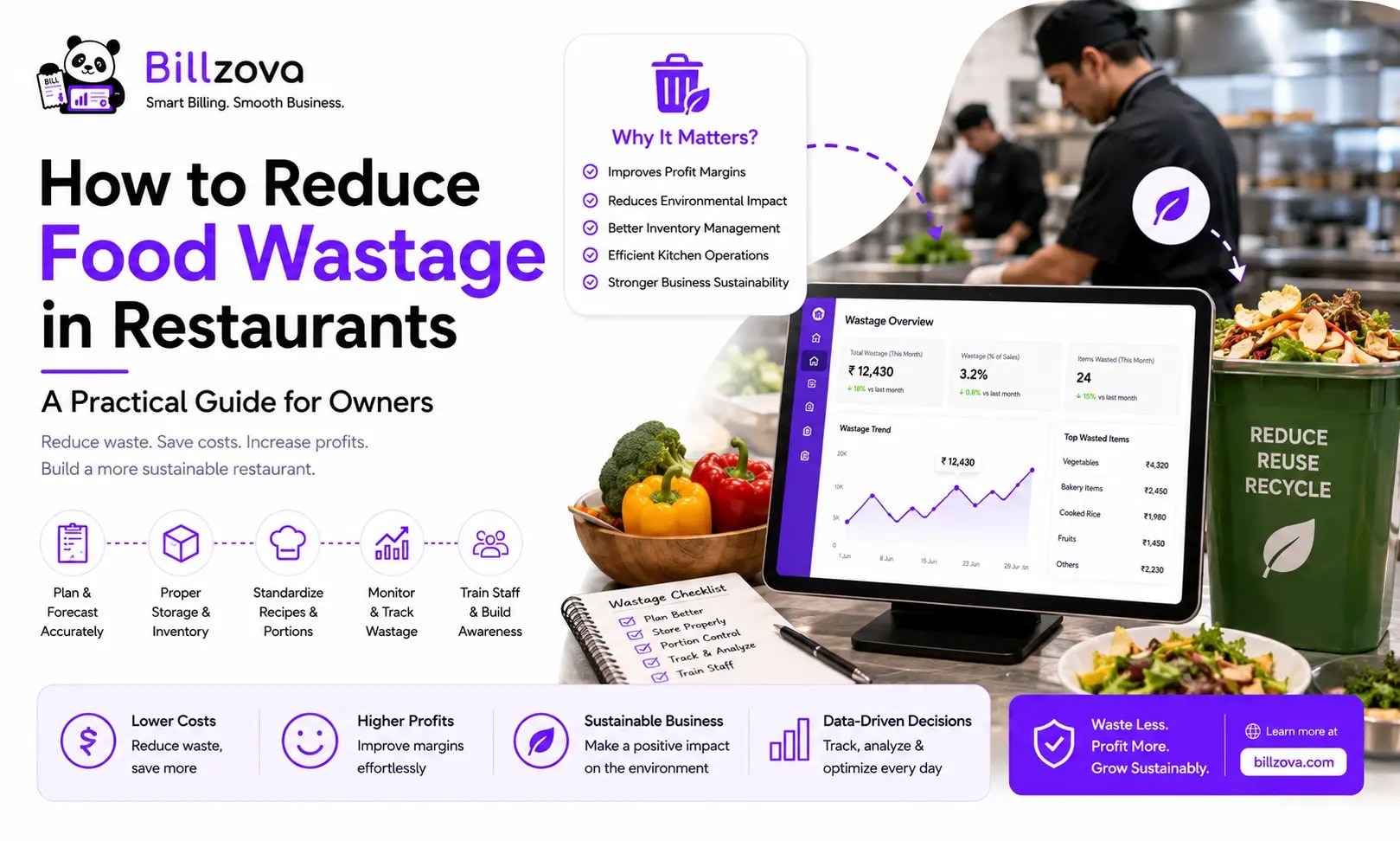
How to Reduce Food Wastage in Restaurants: A Practical Guide for Owners
Food wastage in restaurants rarely looks dramatic day to day. It's a slightly over-prepped batch of a dish that doesn't sell out, a portion that's a little larger than the recipe calls for, a delivery of vegetables that arrives in worse condition than expected and gets discarded without anyone logging why. None of these single incidents feels worth solving on its own — but added up across a month, food wastage routinely eats into margin more than most owners realise, simply because it's distributed across dozens of small, easy-to-miss moments rather than one obvious failure.
This guide breaks down where food wastage actually happens across a restaurant's operation, practical tactics for reducing it at each stage, and how tracking the right data — not just good intentions — is what actually makes a measurable difference over time.
Table of Contents
- Why Food Wastage Matters More Than It Seems
- Where Wastage Actually Happens in a Restaurant
- Reducing Wastage at the Purchasing Stage
- Reducing Wastage in Prep and Storage
- Reducing Wastage Through Portion Control
- How Menu Design Affects Wastage
- Why You Can't Reduce What You Don't Track
- Common Mistakes That Make Wastage Worse
- Best Practices Summary
- Where Wastage Reduction Technology Is Headed
- Frequently Asked Questions
- Conclusion
Why Food Wastage Matters More Than It Seems
Food cost is typically one of the largest line items in a restaurant's expenses, often rivaling or exceeding labour cost. Even a modest percentage of that cost lost to wastage translates directly into reduced margin — and because wastage tends to be distributed across many small incidents rather than concentrated in one obvious place, it's easy for an owner to underestimate how much is actually being lost without specifically tracking it.
There's also a less obvious cost: wastage often correlates with inconsistent portioning, which itself creates a customer experience problem — a dish that's noticeably smaller or larger than what a regular customer expects undermines trust, independent of the cost impact.
Where Wastage Actually Happens in a Restaurant
Wastage isn't a single problem — it accumulates across several distinct stages of operation, each with different causes and different fixes:
- Purchasing: Over-ordering relative to actual demand, or ordering based on guesswork rather than historical sales data.
- Storage: Improper storage conditions leading to faster spoilage than necessary, or simply not using older stock before newer stock (poor stock rotation).
- Prep: Over-preparing batches of perishable components that don't get used before they spoil, or inconsistent trimming/processing that wastes more of an ingredient than necessary.
- Portioning: Inconsistent portion sizes that, when they run larger than the recipe specifies, quietly increase ingredient consumption per dish without any corresponding increase in price.
- Plate waste: Food returned uneaten by customers, which can point to portion sizes being too large or a specific dish not matching customer expectations.
Reducing Wastage at the Purchasing Stage
- Order based on actual sales history, not intuition. If a dish reliably sells a certain quantity on a given day of the week, purchasing should reflect that pattern. Our general restaurant POS solutions track these trends automatically.
- Account for supplier lead time and shelf life together. Ordering a perishable ingredient in a quantity that exceeds how quickly it can realistically be used before spoiling guarantees some loss, regardless of how well it's stored.
- Track supplier quality consistency. If a particular supplier's deliveries arrive in worse condition more often, that's a pattern worth addressing directly with them or switching suppliers, not just absorbing as routine loss.
- Avoid bulk-buying perishables purely for a discount if the realistic usage rate doesn't support consuming the full quantity before quality degrades.
Reducing Wastage in Prep and Storage
- Follow first-in, first-out (FIFO) stock rotation consistently, so older stock gets used before newer stock, rather than newer deliveries being placed in front of and used before older ones.
- Store ingredients at the correct temperature and condition specific to each item — generic storage practices applied uniformly often shorten shelf life unnecessarily for items with specific requirements.
- Prep perishable components in batch sizes matched to realistic same-day usage, rather than large batches "to save time later" that risk going unused.
- Standardise trimming and processing techniques across staff, since inconsistent technique can waste meaningfully more of an ingredient than necessary, especially with items like meat and vegetables that require careful trimming.
Reducing Wastage Through Portion Control
Portion control is one of the highest-leverage areas for wastage reduction, because small, repeated deviations from a recipe's intended quantities compound across every single order of that dish, every day. A kitchen that consistently uses 10% more of a key ingredient than the recipe specifies isn't committing one large error — it's committing a small one, repeatedly, at scale.
- Use standard measuring tools (scales, scoops, ladles of defined sizes) rather than relying on visual estimation. Linking kitchen orders to a KOT printing software reduces errors during preparation.
- Document recipes with exact quantities, and train staff against that documentation directly rather than relying on informal "how it's usually done" knowledge passed between staff.
- Periodically audit actual portion sizes being served against the documented recipe, since drift tends to happen gradually and unnoticed over time.
How Menu Design Affects Wastage
Menu structure itself influences wastage in ways that aren't always obvious. A menu with many dishes that each require a unique, low-volume ingredient increases the risk that some of those ingredients won't be used quickly enough before spoiling, compared to a menu designed around a smaller set of ingredients shared across multiple dishes.
This doesn't mean every menu needs to be radically simplified, but it's worth specifically considering: does a new menu item introduce an ingredient that's otherwise unused elsewhere on the menu? If so, that ingredient's entire purchase quantity depends on that single dish's sales volume, which is a riskier wastage profile than an ingredient shared across several popular dishes.
Why You Can't Reduce What You Don't Track
Most wastage reduction advice assumes you can already see where the problem is — but without actual data, most owners are working from impressions rather than evidence. This is where connecting wastage reduction to real inventory tracking matters: if you know, precisely, what stock should be remaining based on recipe-based deduction from sales, you can compare that expected figure against actual physical counts and see exactly where the gap is, rather than guessing.
This is also where recipe costing becomes directly useful for wastage specifically, not just pricing — if a dish's actual ingredient cost is consistently higher than its recipe-calculated cost should produce, that gap is a direct signal of either over-portioning or wastage during prep, and it points you toward exactly which dish and which ingredient to investigate. See our restaurant inventory software guide and broader restaurant inventory management guide for more on how this tracking works in practice.
Common Mistakes That Make Wastage Worse
- Treating wastage as an unavoidable cost of doing business rather than a trackable, addressable operational issue.
- Only reviewing wastage after it's already a visible problem, rather than tracking it continuously as a normal part of operations.
- Blaming individual staff for wastage without checking whether the recipe or process itself is the actual cause.
- Over-correcting purchasing too aggressively after noticing wastage, leading to stock-outs that cost sales in the opposite direction.
- Not involving kitchen staff in wastage reduction efforts, when they're often the ones with the clearest visibility into where it's actually happening.
Best Practices Summary
- Base purchasing on actual historical sales data, not intuition or flat default order sizes.
- Enforce consistent FIFO stock rotation and ingredient-specific storage conditions.
- Use standard measuring tools and documented recipes to control portion consistency.
- Review menu design periodically for ingredients with risky, low-shared-usage profiles.
- Track expected vs actual stock regularly through recipe-based inventory data, not occasional manual counts alone.
- Treat unusual gaps between recipe-calculated cost and actual ingredient cost as a direct signal to investigate, not background noise.
Where Wastage Reduction Technology Is Headed
- AI-assisted demand forecasting that adjusts purchasing recommendations based on patterns like day-of-week, season, or local events, rather than static historical averages alone.
- Automated cost-gap flagging, surfacing dishes where actual ingredient cost diverges from recipe-calculated cost without requiring a manual review to notice.
- Tighter supplier data integration, helping correlate delivery quality issues directly with specific suppliers over time.
Frequently Asked Questions
What is the biggest cause of food wastage in restaurants?
It varies by operation, but over-ordering relative to actual demand and inconsistent portioning are among the most common and highest-impact causes, because both compound across every order or delivery rather than being isolated incidents.
How can I reduce wastage from over-ordering ingredients?
Base purchasing decisions on actual historical sales data for each dish, rather than flat default order quantities or guesswork, and account realistically for how quickly perishable ingredients can be used before spoiling.
Does portion control really make a meaningful difference to food cost?
Yes — because portioning errors repeat with every single order of a dish, even a small consistent deviation from the recipe compounds significantly over weeks and months of sales volume.
How do I know if my restaurant has a wastage problem if everything seems fine day to day?
Wastage is often invisible day to day precisely because it's distributed across many small incidents. Comparing recipe-calculated expected ingredient cost against actual purchasing and stock data is the most reliable way to surface it.
Can menu design actually affect food wastage?
Yes — dishes that each require unique, low-volume ingredients not shared across the rest of the menu carry a higher wastage risk than dishes built around ingredients used in multiple popular items.
What is the difference between wastage and shrinkage?
Wastage refers to ingredient loss through spoilage or preparation error. Shrinkage is an unexplained gap between expected and actual stock not accounted for by recorded wastage, which can include portioning inconsistency or, in some cases, pilferage.
Does tracking software actually help reduce wastage, or just measure it?
Both — measurement is the necessary first step, since you can't address a problem you can't see clearly. But the visibility itself often directly informs the fix, by pointing to specific dishes or ingredients where the gap is occurring.
How often should I review wastage data?
Regularly enough to catch issues before they become a significant cumulative loss — many restaurants find a weekly review sufficient, though this depends on order volume and menu complexity.
Should I involve kitchen staff in wastage reduction efforts?
Yes — kitchen staff often have the most direct, practical visibility into where wastage is actually happening during prep and service, and involving them tends to produce more accurate and actionable insight than reviewing data alone.
Can reducing food wastage improve my restaurant's overall profitability significantly?
Given that food cost is typically one of the largest expense categories in a restaurant, even modest reductions in wastage can have a meaningful, direct effect on overall margin.
Is recipe costing useful specifically for wastage reduction, or just for menu pricing?
Both — a persistent gap between a dish's recipe-calculated cost and its actual ingredient cost is a direct, specific signal of wastage or over-portioning, making recipe costing a practical diagnostic tool, not just a pricing exercise.
How does Billzova help with tracking and reducing food wastage?
Billzova's inventory management auto-deducts stock based on actual recipes as orders are billed, giving you a real expected-vs-actual baseline to compare against physical counts, plus recipe costing that surfaces cost gaps pointing directly to wastage.
Conclusion
Food wastage rarely announces itself clearly — it accumulates across purchasing decisions, storage habits, prep batches, and portioning consistency, each contributing a small, easy-to-miss amount that adds up over time. The restaurants that actually reduce it aren't the ones with the strongest intentions; they're the ones with real data showing exactly where the gap between expected and actual ingredient usage is occurring, and a process for acting on it.
If you're trying to get genuine visibility into where your restaurant's food cost is actually going, Billzova's inventory management — recipe-based stock deduction, low-stock alerts, and recipe costing — is included standard in the ₹399/month plan. Try the first month free to set up your own recipes and start seeing real data, or talk to our team about your specific kitchen operation.
Billzova Team
Restaurant POS & Billing Experts
We build Billzova — GST billing, KOT, offline mode, inventory and reports for Indian restaurants. This team writes from what we see helping real restaurants bill faster every day.
Run your restaurant on billzova
GST billing, KOT, offline mode, inventory & reports in one app. ₹399/month — first month free.