Restaurant POS Pricing India: Cost Guide | Billzova
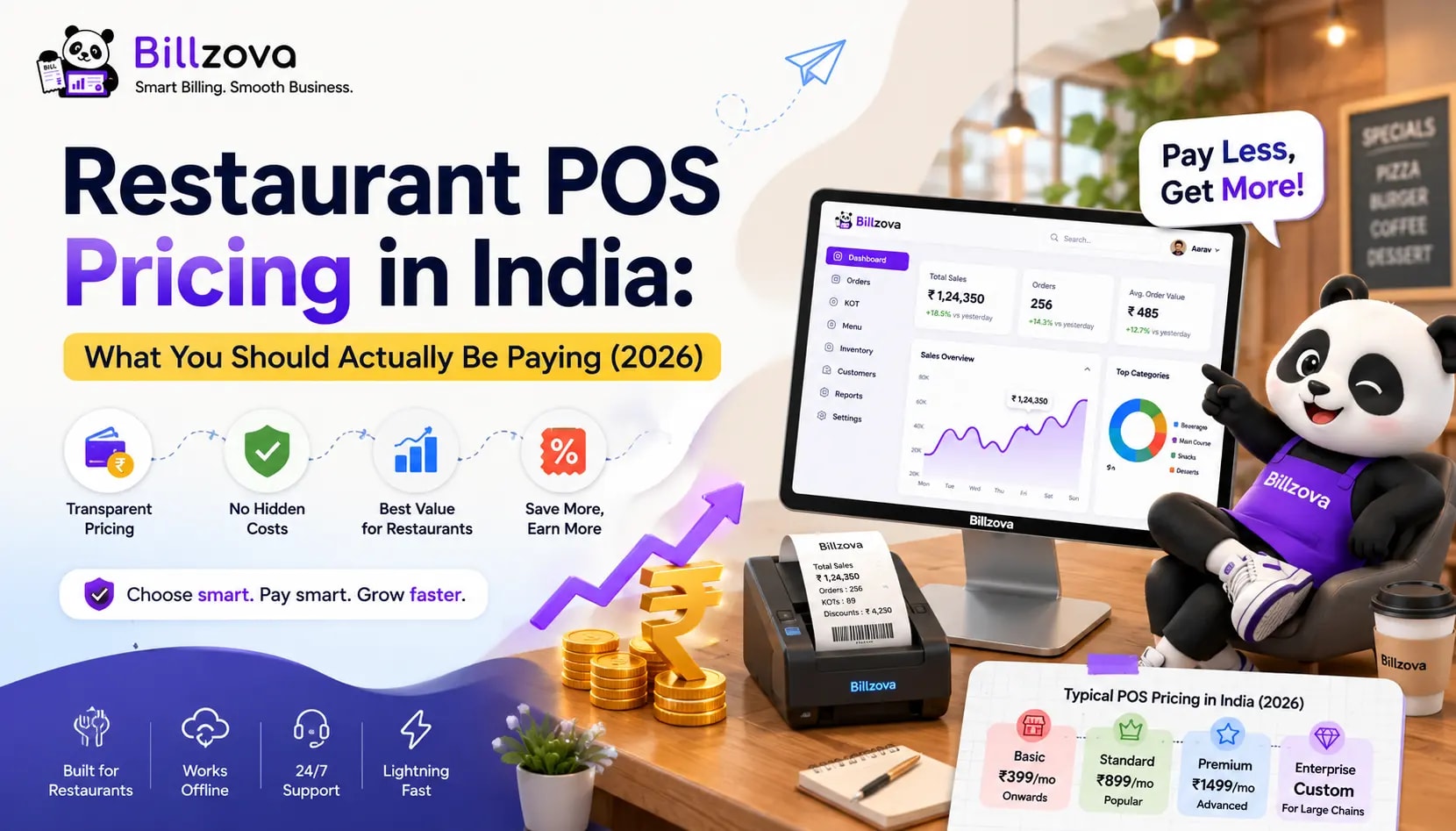
Restaurant POS Pricing in India: What You Should Actually Be Paying
Ask five different restaurant POS vendors in India what their software costs, and you'll often get five differently structured answers — a flat number, a "starting from" figure with unclear extras, or "let's hop on a call." That inconsistency isn't an accident. Restaurant POS pricing in India is genuinely fragmented across a few distinct models, and not knowing which one you're looking at is exactly how owners end up paying significantly more than they expected, three months after signing up.
This article breaks down how restaurant POS pricing actually works in India, what's typically included or excluded at different price points, and a practical way to calculate the real total cost of any system before you commit to it.
Table of Contents
- The Restaurant POS Pricing Landscape in India
- The Three Pricing Models, Explained
- What's Usually Included vs Sold Separately
- Realistic Price Ranges by Restaurant Size
- Hidden Costs to Watch For
- How to Calculate the Real Total Cost
- Common Pricing Mistakes Restaurant Owners Make
- Best Practices Before You Sign Up
- Where Restaurant POS Pricing Is Headed
- Frequently Asked Questions
- Conclusion
The Restaurant POS Pricing Landscape in India
India's restaurant POS market spans an unusually wide range — from free, ad-supported billing apps with minimal functionality, to flat-priced all-inclusive plans around a few hundred rupees a month, to enterprise platforms quoted in the thousands per month once outlet count and modules are factored in. This range exists because the market itself is wide: a single-counter tea stall and a 50-outlet QSR chain have genuinely different needs, and pricing reflects that — at least in theory.
The practical challenge for an owner isn't that prices vary; it's that the same published number can mean very different things depending on the pricing model behind it.
The Three Pricing Models, Explained
1. Flat, Published Pricing
One number, shown on the website, with every core feature included. You know your exact monthly cost before you sign up, regardless of how many staff accounts or how much inventory you configure. This model is most common among software built specifically for independent restaurants and small chains.
2. Modular / Add-On Pricing
A lower advertised starting price that covers basic billing, with inventory, staff management, multi-branch, or advanced reporting sold as separate paid modules. The advertised price is rarely what you actually end up paying once your restaurant uses these additional features — which, for most restaurants, isn't optional extras but core daily functionality.
3. Quoted / Enterprise Pricing
No public price at all. Cost is determined through a sales conversation based on outlet count, required integrations, and support tier. This model is common among platforms built for large multi-outlet enterprise chains, where genuine customisation and deep integration work justifies a tailored quote — but it makes upfront comparison difficult for a smaller restaurant just trying to budget.
| Model | Best For | Risk |
|---|---|---|
| Flat, published | Independent restaurants, small-to-mid chains | May lack very specialised enterprise features |
| Modular / add-on | Restaurants that genuinely only need basic billing | Real cost often exceeds the advertised starting price |
| Quoted / enterprise | Large multi-outlet chains with complex integration needs | Hard to budget or compare without a sales call |
What's Usually Included vs Sold Separately
Across the market, here's what tends to be core (rarely excluded) versus what's commonly sold as an add-on, depending on the vendor:
- Usually included at any price point: basic billing, basic GST calculation, receipt printing.
- Sometimes an add-on: inventory management, customer CRM, advanced sales analytics, multi-branch reporting, staff role management.
- Often a separate, higher conversation entirely: deep aggregator integrations, custom enterprise reporting, dedicated account management.
The middle category is where most of the real cost surprises happen — these are features most restaurants assume are "just part of a POS system" but which a meaningful share of vendors price separately.
Realistic Price Ranges by Restaurant Size
- Single-outlet independent restaurant or cafe: Flat-priced, all-inclusive plans in India commonly start around ₹399–₹500/month for a fully featured system, though basic billing-only tools can be cheaper (with the caveats above).
- Small chain (2–5 outlets): Often still fits flat per-outlet pricing models, typically in a similar per-outlet range if multi-branch is included rather than sold separately.
- Larger chains (6+ outlets) or complex integration needs: More likely to land in quoted/enterprise pricing territory, often several thousand rupees per month once integrations and support tiers are factored in.
These ranges are directional, not exact — the only reliable way to know your actual cost is to get a specific, itemised answer for your specific restaurant, not a generic published "starting from" figure.
Hidden Costs to Watch For
- Per-branch surcharges that turn a reasonable single-outlet price into a disproportionately expensive multi-outlet bill.
- Setup or onboarding fees charged separately from the subscription price.
- Hardware bundling where a "discounted" hardware package actually inflates the effective software cost.
- Support tiers where basic support is slow, and faster response requires a higher-priced plan.
- Data export restrictions, where pulling your own sales data out requires a higher tier or isn't available at all on lower plans.
How to Calculate the Real Total Cost
- List every feature you'll actually use — not hypothetically, but in your real daily operation: billing, GST, KOT, inventory, staff accounts, reports, and multi-branch if relevant.
- Ask the vendor directly, for each one: "Is this included, or is it a separate charge?" Get this in writing, not just verbally on a call.
- Add up the genuine total, not just the headline number, including any setup or per-branch costs.
- Compare that total against a flat, all-inclusive alternative like Billzova's published pricing, to see whether the "cheaper" starting price actually nets out cheaper once everything is included.
Common Pricing Mistakes Restaurant Owners Make
- Comparing headline prices without checking what's included in each.
- Signing an annual contract before confirming real total cost with all the features actually in use.
- Assuming "we'll figure out pricing for extra features later" instead of asking upfront.
- Not asking about per-branch costs before planning to expand to a second outlet.
- Choosing based on the lowest advertised number alone, without weighing reliability, offline capability, or support quality.
Best Practices Before You Sign Up
- Get a written breakdown of exactly what's included at your specific price, not just a verbal assurance.
- Ask specifically about multi-branch pricing even if you only have one outlet today, if expansion is a realistic plan.
- Use a free trial period, where offered, to confirm the system handles your actual menu and order volume before committing financially.
- Revisit your pricing comparison annually — the market and your own needs both shift over time.
Where Restaurant POS Pricing Is Headed
- Growing pressure toward transparent, published pricing, as more owners actively compare options online before any sales conversation.
- Continued bifurcation between flat-priced platforms serving independent restaurants and quoted enterprise platforms serving large chains, with less overlap in the middle.
- Increased bundling of compliance features (GST, e-invoicing where applicable) into base pricing, as regulatory expectations tighten.
Frequently Asked Questions
How much does restaurant POS software cost in India?
It varies widely by pricing model — flat-priced, all-inclusive plans commonly start around ₹399–₹500/month, while modular or enterprise-quoted platforms can run from several hundred to several thousand rupees monthly depending on what's included.
What's the difference between flat pricing and modular pricing?
Flat pricing includes every core feature at one published price. Modular pricing has a lower starting price but sells features like inventory management or multi-branch separately, often making the real total cost higher than it first appears.
Is the cheapest restaurant POS software actually the most affordable option?
Not necessarily — a low starting price with separate add-on charges for features you'll actually use can end up more expensive than a higher flat price that includes everything.
Does restaurant POS pricing typically include GST billing?
It should at a baseline level, but full compliance (correct CGST/SGST splitting, HSN/SAC support) is standard in our GST billing software — confirm this specifically rather than assuming.
Will my POS software cost increase if I open a second branch?
It depends on the vendor's pricing model. Some include multi-branch POS in the same flat price; others charge per additional outlet. Ask this explicitly even if you only operate one outlet currently.
Should I choose quoted/enterprise pricing for a small restaurant?
Usually not — quoted enterprise pricing is generally built for the complexity and scale of large multi-outlet chains, and a smaller restaurant often pays for unused depth under this model.
How do I know if a "free month" trial is genuinely free?
Check whether a credit card is required upfront and whether the trial includes full functionality or a limited version — genuine free trials typically require neither a card nor feature restrictions.
Are there setup or onboarding fees I should ask about?
Yes — some vendors charge separately for onboarding or initial setup. Ask directly whether this applies before assuming the subscription price is the only cost.
Does cheaper restaurant POS software mean lower reliability?
Not inherently — price and reliability aren't always correlated. The more useful question is whether offline billing, GST compliance, and support are genuinely included at whatever price point you're evaluating.
What is a realistic monthly budget for restaurant POS software for a single-outlet restaurant?
For a fully featured, flat-priced plan, budgeting in the few-hundred-rupees-per-month range is realistic in India's current market, though this varies by what's included.
Is Billzova's pricing flat or modular?
Billzova uses flat, published pricing — ₹399/month or ₹3,999/year, with every feature included, no separate modules to purchase.
Conclusion
Restaurant POS pricing in India isn't dishonest by default, but it is genuinely inconsistent across vendors in ways that make headline-number comparisons unreliable. The only way to actually know what you'll pay is to map your real feature needs against what's included at any given price, in writing, before signing anything.
Billzova's pricing is built to remove this ambiguity entirely — one flat number for billing, KOT printing, inventory, and reporting, published directly on the website. See the full pricing breakdown, or talk to our team if you want a direct comparison against what you're currently paying.
Billzova Team
Restaurant POS & Billing Experts
We build Billzova — GST billing, KOT, offline mode, inventory and reports for Indian restaurants. This team writes from what we see helping real restaurants bill faster every day.
Run your restaurant on billzova
GST billing, KOT, offline mode, inventory & reports in one app. ₹399/month — first month free.